
By Ellen Jovin
Welcome back, please do come in, let’s start with a quiz. Your task is to insert an apostrophe where appropriate in the following three real-life publication titles:
- Runners World
- Farmers Almanac
- Publishers Weekly
I’ll be back in three paragraphs with the answers. Don’t cheat.
In the meantime, happy Curmudgeons Day! This is a perfect opportunity to crankily discuss the fact that unless you have a photographic memory, it is challenging to remember where and even if to place apostrophes in constructions like these. If people thought about the holiday name, which most people don’t, some would surely want to use the plural possessive “curmudgeons’.” Others might prefer to use the singular possessive “curmudgeon’s,” but probably not many, in part because of the abundance of curmudgeons.
Fortunately, since today is also Freethinkers Day, we can accommodate diverse viewpoints here.
Now it is time for the quiz answers: Runner’s World, Farmers’ Almanac, and Publishers Weekly. How did you do? The first one includes a singular possessive, the second contains a plural possessive, and the third contains no possessive. If I hadn’t written the quiz myself, I would probably have gotten two out of three wrong, especially since there is a better-known farmers’ publication called Old Farmer’s Almanac where the apostrophe choice went a different way.
In constructions such as Publishers Weekly, “publishers” can be described as an attributive noun, which is a noun acting adjectivally before another noun. That term was not part of my childhood. In the phrase “book cart,” I would back in the day have classified “book” as an adjective, and I would have classified “publishers” as needing an apostrophe. But it is a real and common thing to have attributive nouns, singular or plural, in front of other nouns in English, and as an adult, I am at peace with it.
I regularly see all three options: singular possessive, plural possessive, and attributive noun. If you love consistency, I hope your job isn’t reporting on farmer’s/farmers’/farmers markets.
In Runner’s World, the possessive is singular even though there are a whole lot of runners running around out there. I see that publication name and picture an archetypal fit runner. If they made it Runners’ World or Runners World, it is possible that I, an apostrophe-sensitive person, would picture more runners. Either way, I know the magazine is about running.
Every year I check holiday names. Mother’s Day and Father’s Day are reliably singular, though given the volume of mothers and fathers out there and my less than perfect apostrophe memory, I keep looking them up anyway. I check locks, I check stoves, I check apostrophes. I’ve checked New Year’s, Valentine’s Day, April Fools’ Day, and Presidents’ Day many times.
If you are a writer in the U.S., you may have consulted Writer’s Digest for advice while simultaneously belonging to the National Writers Union, the Authors Guild, the Horror Writers Association, or some other apostrophe-free organization. People who belong to the Writers Guild of America (also no apostrophe) may have professional counterparts across the Atlantic who belong to the Writers’ Guild of Great Britain, where the authorities opted for a plural possessive. Let’s check back in 10 years and see if that apostrophe’s still there.
Sometimes organizations do drop them. Sometimes there is flip-flopping. This can cause outrage and the writing of many passionate emails. I have set up my grammar advice stand next to a number of Kilwins chocolate and ice cream shops around the country. Sometimes their signs and product packaging have had an apostrophe (Kilwin’s) and sometimes they haven’t. I have successfully operated my grammar stand amid apostrophe uncertainty.
Much time has gone into decisions like these across decades. At times people have surely become angry and voices have been raised. In fact, it’s highly likely that someone on the Upper West Side is arguing about this subject this very minute.
By the way, there’s no apostrophe in the National Basketball Players Association, which is for current NBA players, but if you’re playing in the NHL, you get an apostrophe in your National Hockey League Players’ Association.
Occasionally there is certainty. The Children’s Literature Association cannot be the Childrens’ Literature Association or the Childrens Literature Association. And it definitely cannot be the Children Literature Association. Unless you habitually misplace apostrophes in “children’s,” you cannot go wrong here.
While writing this article, I checked up on Reader’s Digest. It’s still hanging on to the same singular apostrophe it had in the 1970s when my little sister and I used to read through stacks of Reader’s Digest issues at our grandparents’ house in Los Angeles. I see that apostrophe and I remember the way the Southern California light came in the room softened by trees as I read. I loved my grandparents so much. It’s nice to see that apostrophe again.
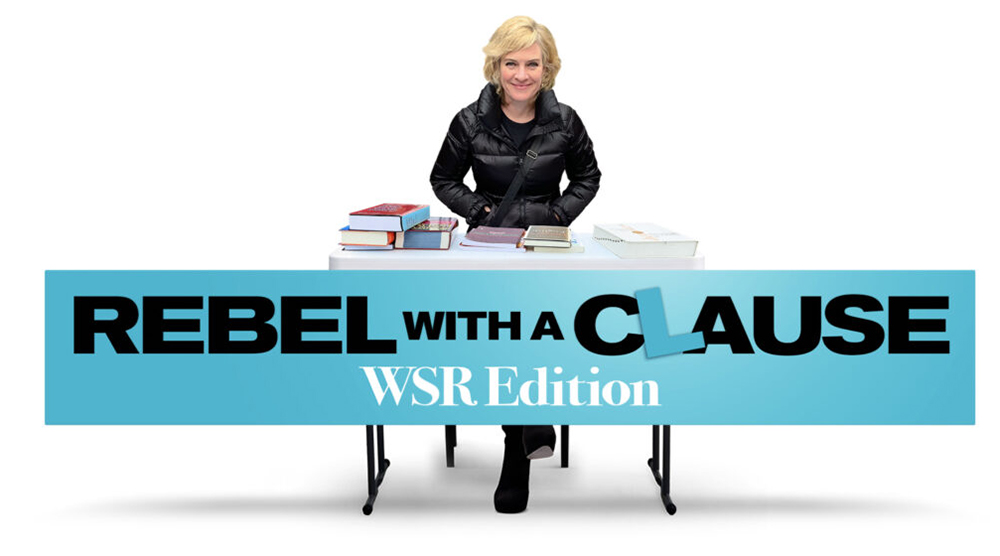
Ellen Jovin is the author of the national bestseller Rebel with a Clause and the subject of a grammar docu-comedy by Brandt Johnson, also called Rebel with a Clause, currently playing at theaters around the country.You’ll find a complete collection of her columns for the WSR — HERE.
Subscribe to West Side Rag’s FREE email newsletter here. And you can Support the Rag here.




It seems to me that if it “definitely” cannot be “Children Literature Society” (which I agree it cannot be). then it shouldn’t be “Publishers Weekly” or “National Basketball Players Association.” In all cases, as you point out, the elimination of the aprostrophe is apparently justified by the noun acting as an adjective. How to reconcile this? The simplest way is to put the comma back in.
The comma?
Ha ha! Caught me! Apostrophe, of course!
Fantastic column!
It so happens that I’ve been dwelling quite a bit on apostrophes in the past few days in my ongoing quest to beautify HTML text formatting algorithmically, not unlike what the WSR comment forum does to our punctuation. I’ve found that FIVE regular expressions (https://en.wikipedia.org/wiki/Regular_expression) are evidently needed to transform the common single quote character (Unicode U+0027) into either a true “modifier letter” apostrophe (U+2BC) or a right (U+2018) or left (U+2019) single quotation mark as appropriate, based on context. (Ellen will be delighted to learn it also implements a proper en-spacing between sentences, regardless of typeface or font size — so long as one remembers to double-space.) Would that all the English prose we encounter on the Web were thus enhanced!
This article’s wonderful!
I tend to defer to “Eats, Shoots & Leaves: The Zero Tolerance Approach to Punctuation,” by Lynne Truss, on punctuation matters. That said, I’m not sure where she comes out on this test. I’m too lazy to check.
these columns are always a pleasure thank you!
If you know anyone with Alzheimer’s Disease and think about apostrophes you might think that the use of the apostrophe “s” means that it is possessed or owned by Dr. Alois Alzheimer who discovered it in the early 1900s. I don’t know if Dr. Alzheimer (no “s” or apostrophe) ever suffered from the disease that bears his name, but regardless, there are too many people suffering who would rather he owned it and not them.
A cityʼs Wendyʼs restaurants planned to stage a parade, but it rained on the scheduled day. Were Wendyʼsʼsʼ efforts in vain?
Now my mind is blown.
Special thanks to you, Ellen, for reawakening everyone’s grammatical knowledge, making it fun and enjoyable, and a topic many of us are now discussing! May I add that both your film and book, “Rebel With a Clause”, are both delightful (and educational) as well. All the best!
Thank you so much, Susan! I really appreciate that!
Except in such cases as plural nouns (e.g., children, as you point out), the use of the apostrophe seems to me to be a matter of the writer’s attitude rather than of clarity. Whether the writer thinks of the particular noun as singular or plural is of little importance to the meaning.
By the way, is there such a person as a happy curmudgeon?
Was there ever such a person as a happy curmudgeon?
Thank you for reminding me of the classic New Yorker cartoon where the kid is making a HAPPY MOTHERS’ DAY card, the teacher points it out, and the kid says “I have two moms! I know where the apostrophe goes!”
That’s pretty clever and it made me chuckle but I think it’s Mothers’ Day because it’s a day honoring ALL mothers.