


By Yvonne Vávra
She fell and then got up again. Fell again, got up again. Once more to the ground, and right back up she went. The woman I was watching on the ice at the new Gottesman Rink in Central Park skated like a true New Yorker: daring, falling, and rising, perpetually. In that way, she embodied the spirit of the rink itself, open for its first season at the Davis Center by the Harlem Meer, after the run-down Lasker Rink was demolished in 2021 and the $160-million recreation space rose from the rubble.
There’s something about ice skating in Central Park, especially when you’re just watching.
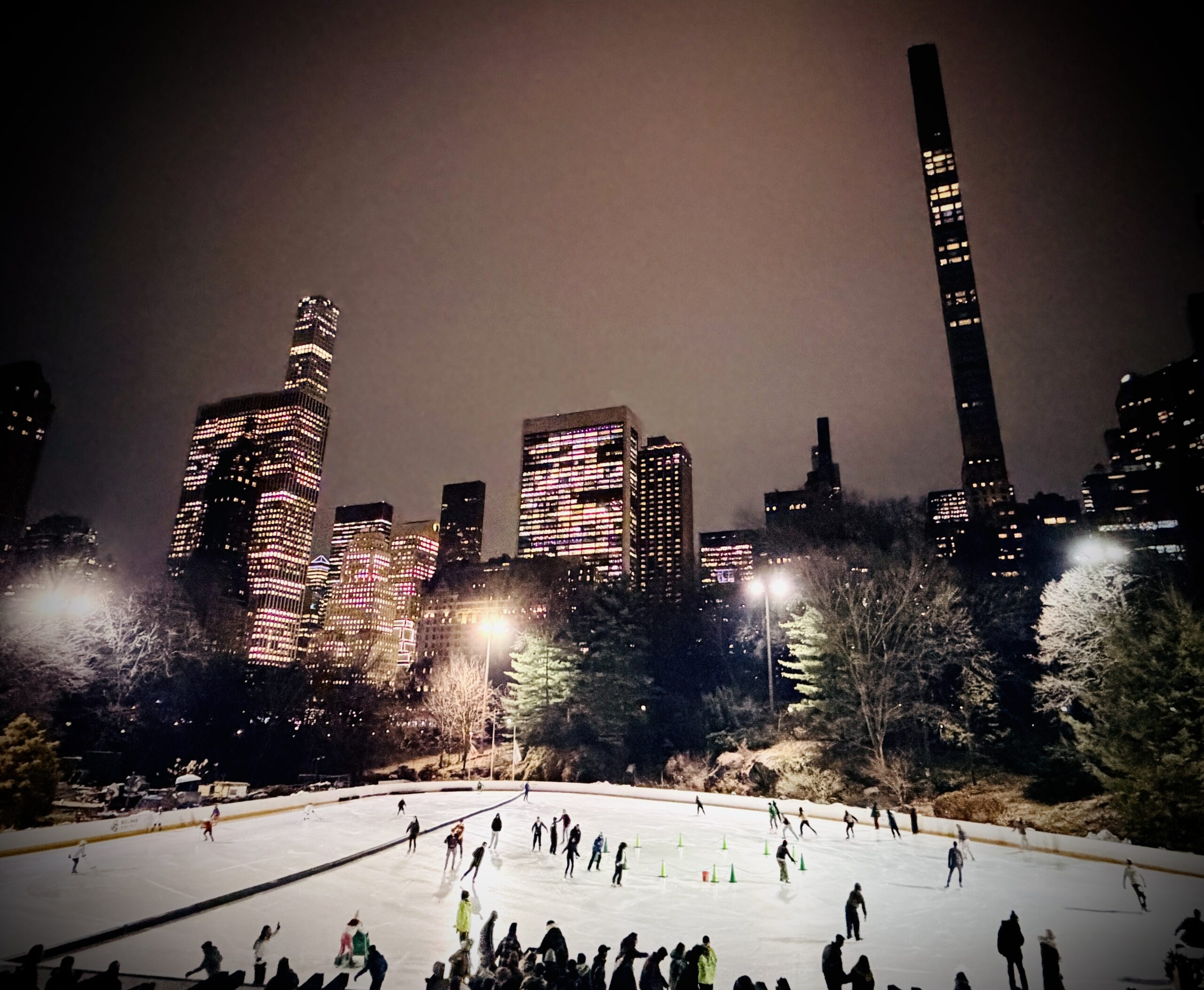 The backdrop to Wollman Rink, at the southern end of the park, is iconic. It takes your cold breath away. You’re inside a coffee-table book of grand New York, watching small figures circle the ice while the skyline behind them holds its straight lines. Skaters loop and stumble below, while the perfectly posed city watches, just like you. You and the city, out on a date.
The feeling is different at Gottesman Rink. Here, the spectacle is framed by tall, straight trees, in a part of the park left closest to Manhattan’s original topography. The woods on the hill feel almost untamed, the opposite of Wollman’s carefully arranged backdrop, and just as impressive. This is the city with its guard down — less makeup, less manicure.
My favorite backdrop is one I’ve never seen in person. It lives in a photograph from the late 19th century: fashionably dressed New Yorkers skating across the frozen lake in Central Park, the newly built Dakota rising at the corner of 72nd Street behind them. It stands there all alone, watching.
I linger over the men in tailored coats and elegant top hats, skating in pairs and small groups, or simply standing around chatting. In a later photograph, taken around 1900, two women in elaborate hats and long coats with puffy sleeves skate arm in arm. By then, the Dakota has a companion: the Hotel Majestic at the southern corner of 72nd Street, newly opened in 1894 — ten years after its pioneering neighbor.

I recognize the Lake, the Dakota, even the small wooden boat landing where I often sit and look toward the Bow Bridge. And still it feels like somewhere else entirely. Without the buildings that now line the park, it’s missing its familiar frame. The city, as I know it, hasn’t arrived yet. All those huge hats certainly don’t help.
The Lake was the first landscape in Central Park to open to the public in December 1858, and New Yorkers flocked to it. 8,000 of them, on skates. Ice skating was hugely popular at the time, in part because it was one of the few socially acceptable ways for women and men to mingle in the 19th century. According to the Central Park Conservancy, as many as 30,000 New Yorkers from all walks of city life entered the park each day, just to glide across the ice.
Ice skating became so hot that it spilled beyond the Lake. Indoor rinks were a huge hit, and the Upper West Side had several of them. In November 1896, the St. Nicholas Rink opened at 69 West 66th Street, on the corner of Columbus Avenue — until last year the site of the ABC campus. It was one of the first indoor ice rinks in the country to use mechanically frozen ice, made in the basement. Lounging rooms with fireplaces surrounded the rink, along with rooms for reading, smoking, and taking tea.
In 1916, restaurant impresario Thomas J. Healy opened an ice rink at his trendy restaurant on 66th and Broadway. In the afternoon, it was open to the public; at night, Healy put on lavish shows featuring skaters of international fame, delighting crowds far into the morning hours.
The show went on even when New York’s ice controller, Benjamin Odell, ordered all rinks to close on March 1, 1918, citing a wartime shortage of ammonia, which was needed to make ice. Both St. Nicholas Rink and Healy’s defied the order. As reported by The New York Times, St. Nicholas insisted they had enough ammonia to last until the end of the season: “We do not desire any more ammonia.”
Odell didn’t care to be outsmarted. Making clear that the state could potentially seize the gas, he replied, “But perhaps we will need that ammonia — perhaps we will need it to make ice for the babies on the east side this Summer. How about that?”
The rinks didn’t care about the babies, they kept gliding on. But soon, St. Nicholas became primarily a boxing arena, and Healy’s skating spectacles eventually fell victim to Prohibition. By that time, he had already had to shut down his other Upper West Side skating extravaganza, the Crystal Carnival Ice Rink at 95th and Broadway, the corner of today’s Symphony Space. The indoor ice age was over.
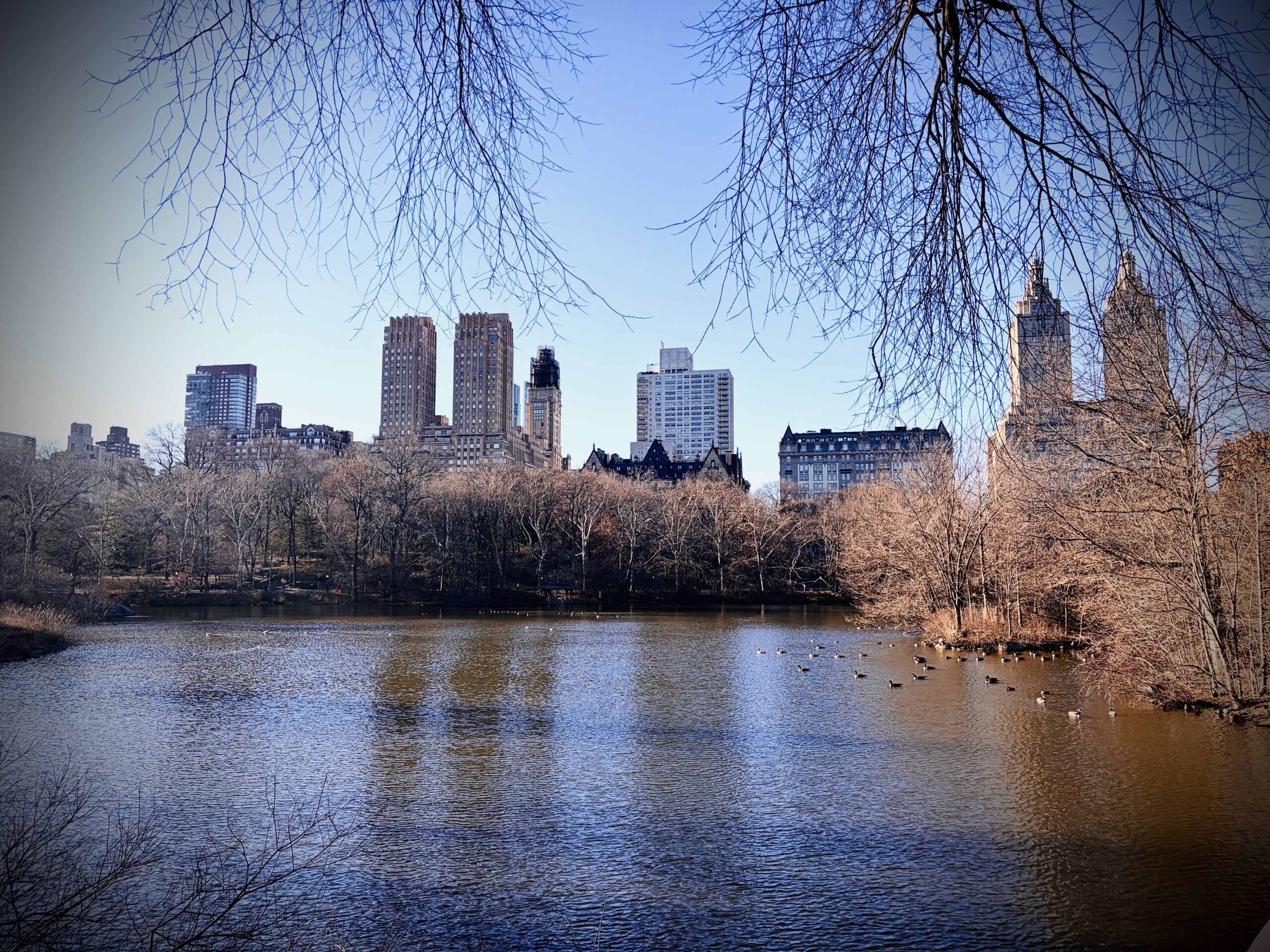
Who would want to skate under a roof anyway, when we have Central Park, where sunlight, moonlight, and city lights compete to shine on us? Still, I find myself drawn once more to the edge of the Lake, trying to skate into the past. I can’t. But the way I know her, the city wouldn’t want me to anyway. She expects me to be present, eyes forward, for the whole new New York she can’t wait to show off. If I had one wish, though, it would be to bring back the elaborate hats.
Yvonne Vávra is a magazine writer and author of the German book 111 Gründe New York zu lieben (111 Reasons to Love New York). Born a Berliner but an aspiring Upper West Sider since the 1990s (thanks, Nora Ephron), she came to New York in 2010 and seven years later made her Upper West Side dreams come true. She’s been obsessively walking the neighborhood ever since.
Subscribe to West Side Rag’s FREE email newsletter here. And you can Support the Rag here.



If you love Skating, you should know the history of Rockefeller Center.
I taught they are for 31+ years
Everyone knows what it looks like during the holiday season with too many skaters on too small an ice surface
But…
other times it becomes a Secret Private place ,
Meaning the regulars who Skate there usually five days a week are very devoted skaters at all levels and all ages.
Who would guess?
I’m a West Side or myself . l’d ove to talk with you if you’d like.
I have stories!
WHAT ABOUT THE CORNER OF 96TH AND WEST END AVE——“RIPS” WHICH WAS A COUPLE OF TENNIS COURTS ON THE SUMMERS AND FROZEN OVER FOR SKATING IN THE WINTER IN THE
1940s ??
For many years, I worked at the AP Building at 50 Rockefeller Plaza, kitty korner from the rink. From the 4th floor office window you could watch the skaters. I never skated there, though, going to wollman instead. I regret that now, 21 years after leaving there. I’ll bet it was fun gliding past golden Prometheus.
it would be wonderful to be able to skate in certain safe areas of the lake again-i wonder if it still gets adequately frozen
Love your posts and love this one, too. I don’t skate myself – this body won’t manage hard falls anymore – but I adore watching people skate, especially those who are just figuring it out, braving it out, laughing it out, teaching it to little (and not so little) ones. Some years back, a next door neighbor used to stride to the park some weekend mornings, with a standard bed pillow at hand, and an extra scarf to secure the pillow around her daughter’s midriff. Cushioning for small butt and tender hips. No one batted an eye, of course, this being New York. Now, I gotta get myself to the new rink for some skater-watching! Take good care!
A shame you don’t mention that the $160 million taxpayer funded rink doesn’t offer ice hockey to our local youth. Another example of the City’s elite not caring about our future. Enjoy skating!
It’s not a shame at all, it’s an article about the history of skating in NYC. If you want to write an article about funding public projects, go ahead, but make sure you get your facts straight: $100 million in private money was donated together with $60 million from the city to build the Davis Center. Also, there most certainly still are hockey programs at the new rink, you can read all about it here: https://daviscenter.centralparknyc.org/skate/hockey
But it does!!
I grew up on the Upper West Side and after 51 years in Bellport came back to the UWS. Here is a list of places that I could skate at when it was cold enough in the 1940s to the 1960s, The ‘Classic Playgroung’ in Riverside Park by the river at about 75th Street had a sprinkler basin that would be flooded for skating on very cold days. It was a very safe place to skate as it was probably only 6 inches deep at the center. The lake by Belvedere Castle would freeze . I remember one time a number of us had to use snow shovels to clear an area for skating. Conservatory Pond by Fifth Avenue was anothrr good place (I went to HS on the East Side) and my mother would meet me there with my skates after school. And if it was cold enough for long enough the real treat was the large lake in the middle of the park.
I grew up on the UWS in the 1940s and there was a skating rink at 96th and West End, where the school now is. I think it was called Rick’s.
I’ve skated on the pond and lake in Central Park up till the ’90’s. Much less supervision then!
Yvonne makes me want to drop everything and go skating at night, which I probably haven’t done since ‘94 at Wollman. I forgot how much fun that is.
Appreciate all the research done to make this a most interesting and informative article focused on a historical look at the rinks of Central Park and the Upper West Side up to the present. It flows like an Olympic skater on brand new ice and entertains without the obstruction of those tall hats. Bravo.
Why doesn’t the CPC allow skating on the model boat pond, when frozen, anymore? Skating was allowed until about 2012. There were brooms and shovels kept in the “boat” house.
Is Wollman still incredibly loud for public sessions?
The ice at Gottesman is terrible. Perhaps it can be fixed for next season. But no point in using good figure skate blades there, unless you want to dull them fast, and that will ruin them — unlike hockey blades.
Back in the 1990s, skated on the lake, within view of the Dakota, a few times. Cops wouldn’t chase us on to the ice.
I took a group of young children for ice skating lessons at Rockefeller Center for many years, and it felt very claustrophobic (inside and on the rink). I found it disturbing that we had to repeatedly bypass lines of angry people hurling insults at us as for ‘cutting the line,’ even when I tried to explain that we had scheduled lessons. Once we switched over to Wollman Rink it was a much happier and more comfortable experience for everyone all around.
Beautiful story, will share with my family, thank you
I grew up in the ’40s and skating at Rip’s, on West End Ave., was the place to go. We warmed up with steaming cups of watery cocoa and were supremely happy.
Another amazing piece of writing by Yvoone!
I’m so glad you mentioned and showed the 19th century photo of skating with the Dakota in the background. It’s pictured in Time and Again by Jack Finney which is practically my favorite novel.
I was glad to see a mention of Conservatory Pond which I believe is now the model boat pond. My dad won the Silver Skates competition (run annually then by the Daily News) in the midget division in February 1934. I am proud to report that my son continues the winning speedskating family tradition.