


By Yvonne Vávra
The ghosts are on my heels.
Last weekend, I wrote about how the uncanny doesn’t wait for Halloween to slip through the cracks, but instead, lingers on the Upper West Side all year long. This week, it caught me off guard again.
I was walking through Riverside Park South in the 60s, gazing at the old pilings rising from the water. They’re so familiar along the Hudson that I usually don’t even register them — they leave my mind alone. But not that day. They were looking at me. Huddled in clusters, peering out of the water, waiting. And that rusty steel skeleton towering over them, half-swallowed by water and time, definitely groaned and rose a little.
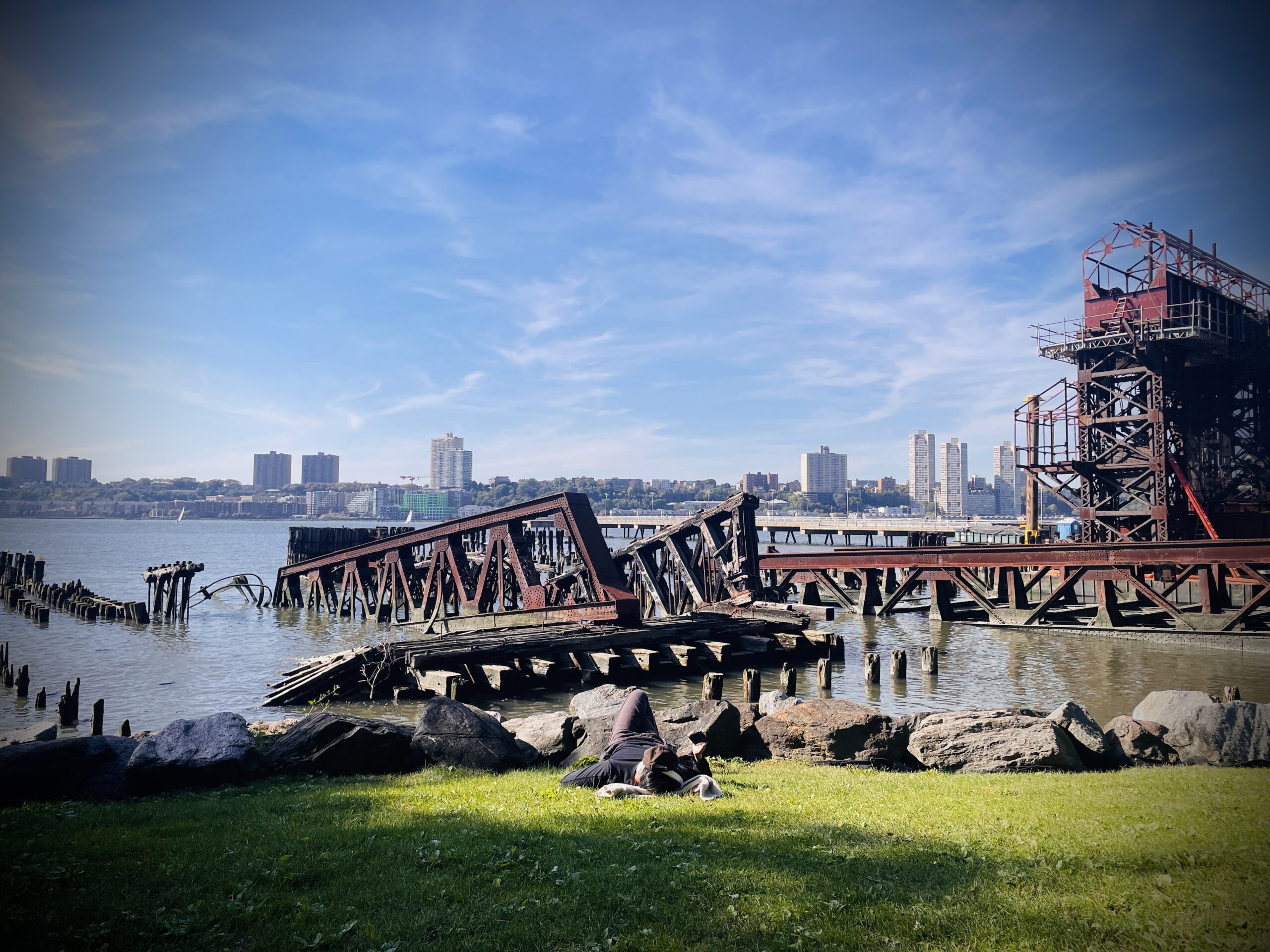 Do you know that feeling when you stare at something so long it starts to play with you, happy to have your attention? The longer I looked at those ghostly pilings, the deeper I slipped into a soft spot in time, back to the Upper West Side’s industrial heyday, when that steel skeleton handled freight trains, the pilings held up huge piers, and people bustled around tracks, smoke, clatter and whistles. Wait — did I not just hear a train rattle by? Did I get lost in a glitch in the city’s memory? How do I get back to the future?
All good — I did hear a train rattle by. The Amtrak Empire Line still runs beneath Riverside Park, very much in the present. Even so, this stretch from West 59th to West 72nd is a perfect place to reflect on our city’s addiction to moving forward. New York usually can’t get rid of its past fast enough — anything that stands in the way of whatever comes next. But here, our little restless dreamer got stopped. It’s like the city tried to shove its industrial heritage into the river mafia-style, only to have the bones stubbornly float back up. And now those ruins in the water and the glassy luxury towers on the other side of the park stare at each other, a bit bewildered by each other’s presence, but making it work.
One thing’s for sure: the towers wouldn’t be here if it wasn’t for these old tracks and pilings. This area was once a key player in turning the growing city into an empire. The opening of the Hudson River Railroad in 1846 connected New York to the rest of the country, giving it access to major trade routes and fueling its rise as a commercial and industrial powerhouse. Back then, the Upper West Side was still mostly rocky, swampy countryside, where pigs and goats made up a notable share of the local population, and what’s now the park was still underwater.
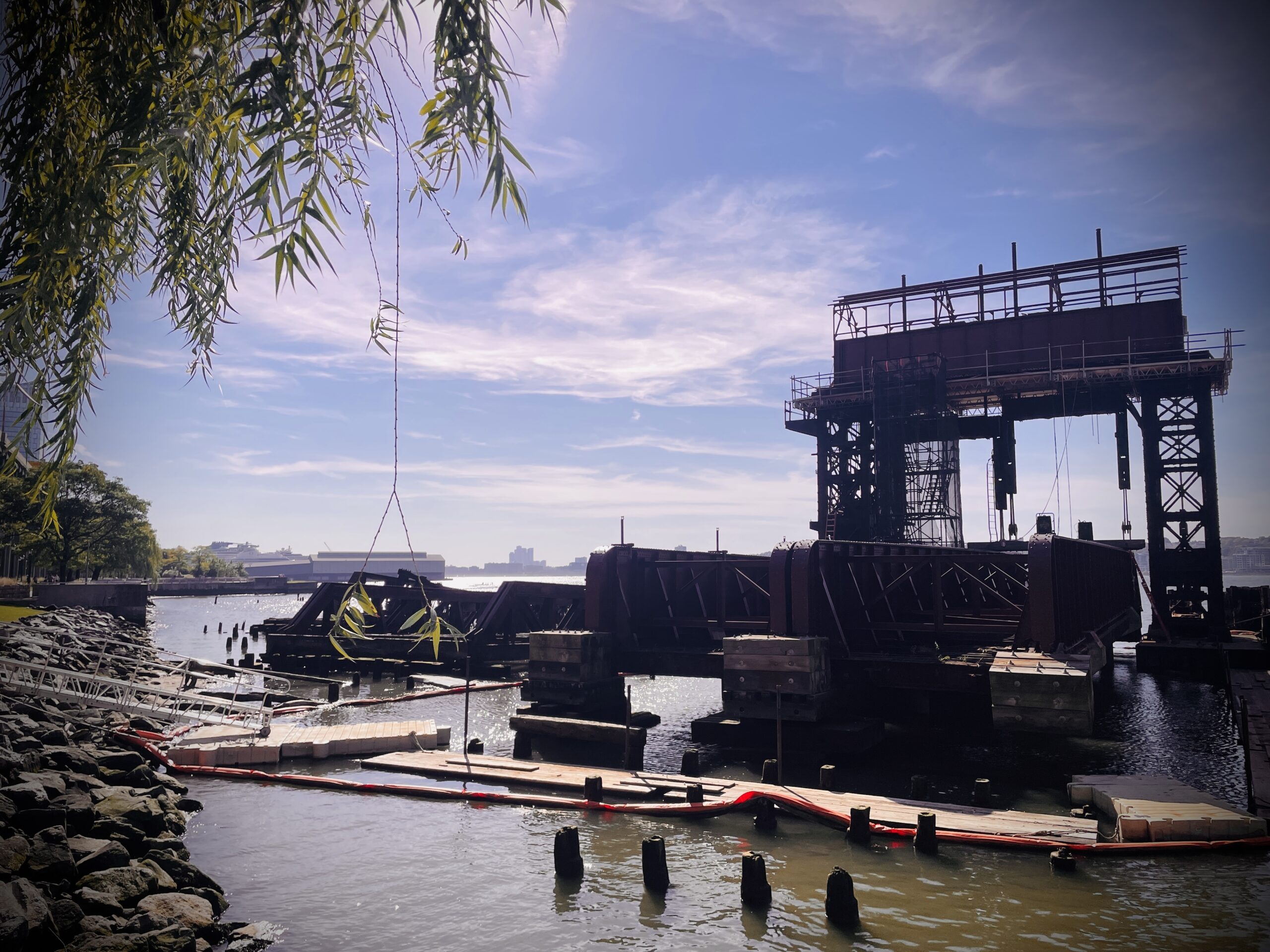 By 1880, the area had been filled in with landfill and became the New York Central Railroad’s 60th Street Yard, where Manhattan’s freight train business was handled for over a century. Our skeleton in the water—the 69th Street Transfer Bridge—was built in 1911 to connect rail and water traffic. Railroad car floats would dock here to transfer train cars between New York and New Jersey. The bridge was deactivated in 1968, and by the 1980s, the yard had been abandoned.
The city moved on. Some of the relics were destroyed by fires, others removed when Riverside Park South was created, starting in 2001. But a few of them managed to stick around in rusty grace until the park decided to keep them. In 2003, the bridge was added to the National Register of Historic Places.
 This weekend, Open House New York offers rare access to the locomotive that was added to the park in 2006 to complete the railroad vibe. This 95-ton engine was built in 1946, once labored in Brooklyn’s waters, and is now enjoying its retirement on the Upper West Side. It’s identical to the locomotives that once hauled freight cars through the 60th Street Yard.
Take the chance to look around because change is coming again. The Transfer Bridge is currently getting a makeover, and as part of the project, 65 of the old pilings are slated for removal. Their perch is on the line.
And I’m sad. After our little trip through time, I want every single one of them to keep huddling and peeping. They’re not just old wood rotting in the waves anymore. So much life and change they’ve seen. And they’re honorable little New Yorkers, too. These pilings weren’t just holding up any pier. They supported bulk cargo piers like the one at 64th Street, where much of the city’s grain, milk, and vegetables once came through.
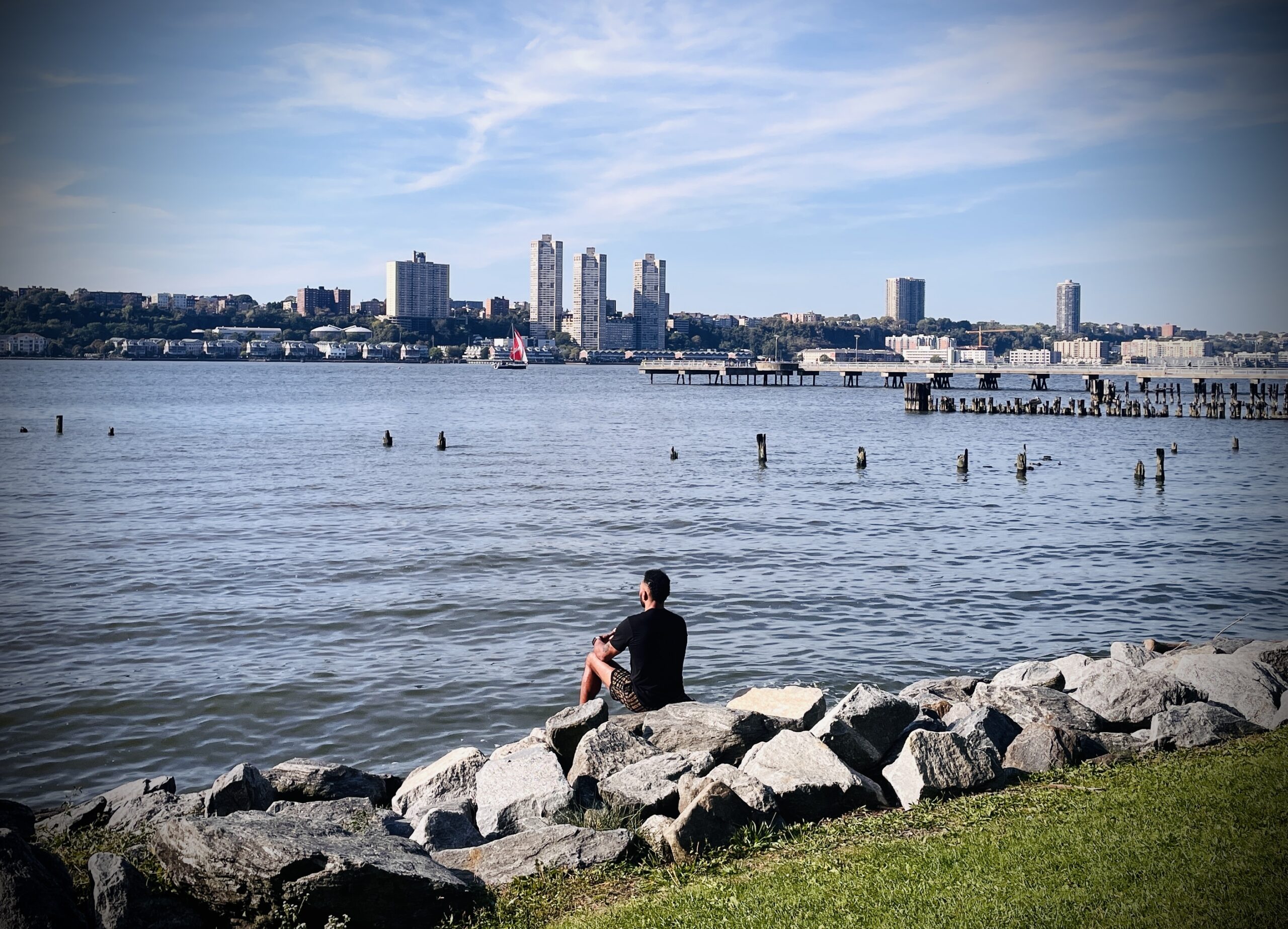 That’s not all. After the pilings piqued my curiosity, I looked into what’s happening beneath the surface. Turns out, there’s some spooky stuff going on down there. The pilings are home to many species, including blue crabs that can shed and regrow their legs when threatened, and naval shipworms that use a helmet-like shell to bore into the wood, leaving behind tiny tunnels that become homes for all sorts of underwater characters.
As New Yorkers, they’ll know how to move on when their homes are pulled away. And we’ll have to, too. Sometimes it takes losing a few pilings of the past to remind us why it matters. So maybe we’ll pay more attention to the ones left standing, appreciating this rugged little skyline in the water more than ever.
 Yvonne Vávra is a magazine writer and author of the German book 111 Gründe New York zu lieben (111 Reasons to Love New York). Born a Berliner but an aspiring Upper West Sider since the 1990s (thanks, Nora Ephron), she came to New York in 2010 and seven years later made her Upper West Side dreams come true. She’s been obsessively walking the neighborhood ever since.
Subscribe to West Side Rag’s FREE email newsletter here. And you can Support the Rag here.



Thank you Yvonne. Lovely article.
Beautifully and lovingly written. Thanks for reminding people about the past and encouraging them to learn and appreciate the local history. NYC: ever changing and yet still there, buried in our memories, and in the water.
Lovely homage to our past. Time for another visit.
Great essay! I’m sure a lot of us remember the ruins of the 60th Street Railyard warehouse which rose out of the river like some sort of zombie roller coaster. I miss it!
https://tinyurl.com/ssd7373a
Terrific essay, Ms. Vavra. You put into words what I feel walking in Riverside Park down by Pier i and Waterline Square — the old and the new “a bit bewildered by each other’s presence.” Thank you.
“This 95-ton engine was built in 1946, once labored in Brooklyn’s waters” Was it a submarine? Would have loved to see that. A NYC miracle that would be equal to Zohran’s free everything..
Can’t people ever shut up about politics? Go start a podcast and leave the rest of us alone. You’re boring.
I loved this piece, and especially this line: “Do you know that feeling when you stare at something so long it starts to play with you, happy to have your attention?” I don’t think anyone has described this feeling before in such a poignant way. Thanks for the wonderful article.
A genius observation, I agree! More of us should be thinking and talking about “reality” exactly like this.
Beautiful piece! Love these ruins.
I love the transfer station, the pilings and this piece!
These ‘ruins’ are glimpses into the past, a critical part of creating context for the present, and help guide us to a better future.
I love you Yvonne Vàvra!
Yvonne Vavra’s little essay is gorgeous, evocative and tear inducing in its beauty. I’ll never look at that area the same way. Many, many thanks for the best Saturday morning read in a long time.
One of my favorite things about that stretch of shoreline is seeing the gulls, cormorants, even the occasional heron, taking a break on top of those pilings. Often each one is occupied.
I was so disappointed to learn these pilings will be removed; not sure I’d be satisfied even if I knew the reason. Thank you, Ms Vávra, for once again capturing the feeling so many of us share about this neighborhood.
A dock was destroyed years ago in a hurricane in the West Harlem Piers Park and has yet to be repaired in years. Please address.
Great writing! Long live the 69th street transfer bridge, I love getting a beverage at Pier i and sitting their for a bit just to look at it
Beautiful essay, as always, Yvonne!
Some of the details of the following story are a little vague, but here goes. As another commenter alluded to (with a link to photos!), the pilings were once part of Piers C and D, which were part of the historic train/waterway system. One of the piers was most twisted metal which became known as the Spaghetti Pier, while the other stood for a long while as a large warehouse that was only its skeletal frame, a beautiful lattice of lines that looked like a giant kinetic sculpture.
Several fans of the structures banded together, myself included, and we photographed them, and eventually worked to save them from being torn down by none other than Trump, who wanted the views of his buildings and the redeveloping mark unobstructed by what non-fans considered eyesores. I wrote a letter to the Times which was published (https://www.nytimes.com/2003/09/10/opinion/l-rotting-piers-a-forlorn-beauty-to-savor-228613.html). Here’s what I wrote:
It would be a terrible artistic loss for New York City if the abandoned piers adorning the Hudson riverfront in the 60’s were demolished and removed to make way for a new project, apparently their fate.
Since the advent of the renovated path along the Hudson, these amazing structures, beautiful in their decay, have been highlights of my daily bike ride.
There is nothing like them in the city. They possess a lonely and bittersweet beauty of things passing away. As long as they do not present a danger to people, they should be allowed to stand — and fall — in their own inimitable fashion.
JOHN K. STONE
New York, Sept. 4, 2003
The Parks Commissioner (I believe it was Adrian Benepe at the time) erected a plaque that acknowledged our efforts to save the piers. Ultimately, we lost, and so did (I believe) NYC and its maritime history.
Your piece reminds me that Manhattan is an island, beholden to the sea.
Awww. I loved this article. And I wish we could sometimes just “leave well-enough alone.”
Funny you mention the blue crabs. My canoe club at Pier 96 sees their shells from time to time on our docks as the geese (who by the way poop nonstop on our docks) are hunting them.
I think about these relics all the time – lovely article