
 Introducing a new biweekly column by the Upper West Side’s own Roving Grammarian.
By Ellen Jovin
I have had more conversations about the Oxford comma—the comma preceding the conjunction toward the end of a list—than almost anyone in this country. That’s partly because I have taught writing and grammar classes to adults for much of my life, but it’s mostly because I have a pop-up grammar advice stand, called the Grammar Table, that I have taken to all 50 states to answer the grammar questions of total strangers.
The Oxford comma, also known as the serial comma, is intoxicating to the American punctuation imagination. No grammar topic inspires more questions, comments, anecdotes, and complaints than the Oxford comma.
When I am sitting at my Grammar Table in Verdi Square, New Yorkers who won’t consider breaking their stride to chat with me will still yell out things like “Oxford comma or bust!” or “Oxford commas forever!” as they head into the 72nd Street subway station.
Oxford-comma fascination fascinates me because it is about so much more than a wee squiggle on a page. The Oxford comma is a friend that almost everyone knows. Like Joe at the deli or Marie at the gym, there’s that good ol’ Oxford, semi-reliably slouching to the left of the “and” in a list.
“What are your views on the Oxford comma?” you can inquire during an awkward pause at brunch. As a social strategy, that will probably work better than inquiring “What are your thoughts on commas in nonrestrictive one-word appositives?” or “Do you always use a comma before a coordinating conjunction when it combines two independent clauses, or do you sometimes find it superfluous?”
I would rather refer to Oxford commas as serial commas, but if I do, people often look at me blankly. They may think I’m saying “cereal comma,” as in “Karl loved Cocoa Puffs, Trix, and Fruity Pebbles.” To avoid trouble, I just go with the comma-naming flow.
One Oxford comma beef I have is with the lack of conjunctional consistency in its application. People worry about the comma before the “and” but regularly ignore “or,” which is also a coordinating conjunction and also appears in lists. If you’re going to get bent out of shape about the comma before an “and,” why not stick up for the “or” comma, too? For example: “In my household, there were no Cocoa Puffs, Trix, or Fruity Pebbles.”
Poor or.
As for me, I can go either way on Oxford commas. It’s a style choice, but I get the attraction to a reliable rule. People like patterns and routines. If your underwear usually goes in the top drawer, mostly you don’t like it when someone drops it in the second drawer. Oxford commas work like underwear.
A few years ago, a couple of women complained to me that men were putting their Oxford comma preferences (definitely pro) in their online dating profiles. The women were not amused. They swiped left.
Even though Oxford comma users are on average more committed than nonusers, there is passion on both sides. I recently received an email with the adamant postscript “No miserable Oxford comma for me!”
Some Oxford comma absolutists are current or former journalists who follow, or used to follow, Associated Press style, which governs a lot of what we see in newspapers.
Some years ago, I submitted an article to a U.S. newspaper. Before publication, I found that a critical comma in a list had been removed. The trouble-causing sentence was patterned like this one: “At the picnic, I ate spaghetti and meatballs, macaroni and cheese, and lasagna.”
See that comma after “cheese”? I had a cheeselike comma in my sentence and they took it out. That was not OK with me, so emails promptly began to get written. The Associated Press does not deny people the right to use Oxford commas. That people think it does is typical of the trouble we have with many types of human knowledge. People oversimply, misremember, and fetishize. That’s what has happened with the Oxford comma.
If more AP style followers consulted the actual Associated Press Stylebook rather than their memories of it, they would see that it endorses the serial comma in cases where omitting it would make the meaning unclear, or where one of the elements includes a conjunction, or where the list consists of complex phrases.
It took a few emails, but my cheese comma was eventually returned to me.
The Oxford Comma Wars seem likely to continue unabated. Fortunately, unresolved sentence skirmishes serve an important societal function: They keep us talking, and then afterward, we can still hang out and get along.
As one person recently emailed me, “I’m definitely on Team Oxford Comma, but I like to think that I’m open-minded and nonjudgmental enough to still be friends with those on the wrong side.”
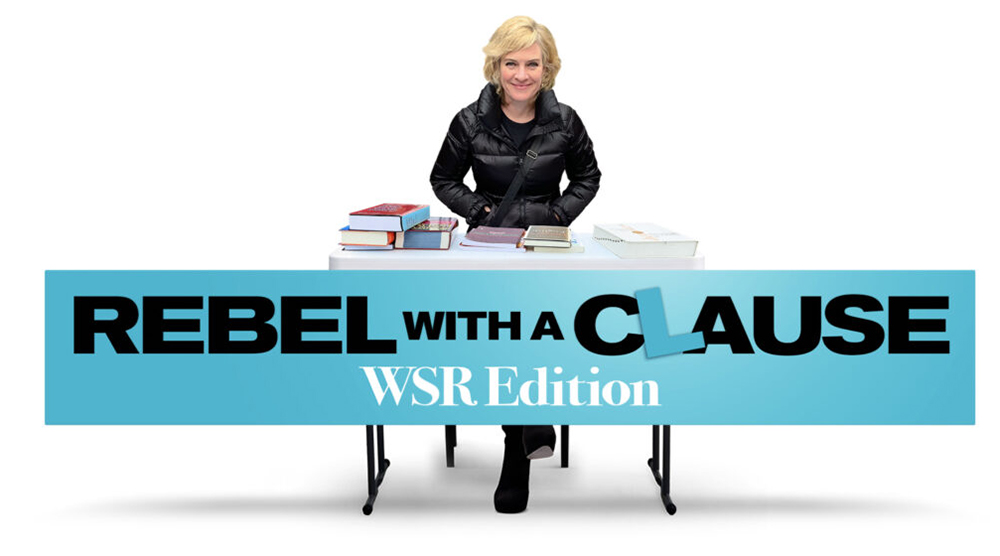
Ellen Jovin is the author of the national bestseller Rebel with a Clause and the subject of a new docu-comedy by Brandt Johnson, also called Rebel with a Clause, which is currently in residence at New Plaza Cinema on the Upper West Side and playing at theaters around the country.
Subscribe to West Side Rag’s FREE email newsletter here. And you can Support the Rag here.




I once worked for a law firm that was sued for malpractice for wont of a comma in a contract. It settled for $60 million. That said, I’m generally against the oxford/serial comma unless the list is very long and complicated (like in a contract).
RCP: Do you mean the law firm was sued for the lack of a comma for for the custom of using it? I think you mean the former, and in that case it should be “want.” If you mean the latter, I do apologize.
OR for the custom of using it? Sorry.
terrific!
Great article!
I have not achieved the ability to be non-judgmental when I “see” a “ missing” Oxford comma— it’s just screams ignorance to me—not sure I can evolve to that point!🤯
Thanks!!
I’m anti-Oxford. The New Yorker published a letter of mine and when they sent me the edited version for approval they shortened it and added six or seven commas. I laughed. Of course. My nickname for this venerable magazine is “Comma Vomit.” Thanks for this piece.
Agreed, Oxford Comma is unnecessary. Someday I hope to discuss this with Doug Garr, a poodle masseuse and the world’s foremost expert on toenail art.
LOL
ISWYDT
I HATE the serial comma, but even more so editors who insist upon it. I literally had to go through the first edit of a book I wrote and do page/line fixes (deletions!) of hundreds of serial commas despite having been very clear that I only use them if there’s a clarity issue. Now, I don’t really hate my editors–they otherwise did an excellent job–but there is simply no need for the serial comma. It’s a waste of a keystroke! Glad to see this column.
Oxford commas forever. That is all.
But I can understand Ellen Jovin’s agnosticism.
Loved this article.
Now can we please have one on the much-maligned semi-colon?
My late husband worked at The New Yorker (Oxford comma), his mother worked at Fortune (Oxford comma, at least in her day) and I worked at The New York Times — no Oxford comma. My husband and I spent an inordinate amount of time arguing about the Oxford comma. Thanks for this fun column. You and Mary Norris, the Comma Queen, may single-handedly save the Oxford comma from extinction.
There is an excellent pro-Oxford comma illustration that’s a little “NSFW” so I won’t try to link to it, but interested parties can search “Oxford comma JFK Stalin” and will see a humorous, pro-Oxford comma meme (and my favorite demonstration of the comma’s necessity).
Definitely yes to the Oxford comma. I’ve seen countless situations where adding the Oxford comma reduces or eliminates ambiguity (including this very famous case: https://stancarey.wordpress.com/2014/09/15/oxford-commas-nelson-mandela-and-stephen-king/). I’ve yet to see a case where using it actually causes ambiguity or reduces clarity in a sentence.
I am pro Oxford comma and cannot understand those too lazy to use it.
Like TP rolling from the top, Hellman’s vs. MiracleWhip, and the Oxford comma, we all make choices although some are wrong! 🙂
Oxford comma yes.
Underwear in the second drawer? Now THAT is going too far!
I understand personal preference (to a degree), but have trouble understanding why anyone would fight ferociously for the Oxford comma. Clarity and comprehension for the reader should always be top-of-mind, and too many commas–especially ones that are not completely necessary–slow the reader down. In my view, including the comma immediately before the end of a list disturbs the rhythm of a sentence.
I’m so excited to read about this new regular column! (Big serial-comma fan here, but my husband is anti-, so I’ve learned to co-exist with those in the opposite camp.) Could a future column address comma splices? Bane of my existence!
Here’s the description for an upcoming Rick Steves’ Europe episode on Spectrum: “The capital city of Dresden, Germany’s palaces and art of the Wettin dynasty; Leipzig’s Bach heritage, a monument to the day Europe beat Napoleon and museums” (July 20, 5:30pm)
The day Europe beat museums was a bad day indeed.
When I attended public school in New York in the 1950s and 1960s, we did not punctuate using the Oxford comma. But in the 1970s it was everywhere. What happened?
My own guiding principle for writing: Keep it as simple as possible, and omit anything that is not necessary to keep my meaning clear. Call it Occam’s Razor or “Keep It Simple, Stupid”. The fewer characters it takes to express my point, the less likely it will be that a reader will find a way to be confused.
There is no need for the serial comma except in some instances, such as the quoted “macaroni and cheese, and lasagna” example, where there is in fact need for it. Therefore, it gets omitted unless needed to keep the meaning clear.
I’ve never understood the slavish devotion of some people to “always the comma” or “never the comma”. Use the comma when it’s needed for clarity. Omit it when it isn’t.
Simple.
In publications it’s easier and cleaner to have the same style always, so you just use the serial comma in all lists. Many house styles rely on such consistency. Retired copy editor here.
Hi, Ellen. Thanks again for that wonderful movie. As a writer, I’m pretty much a fan of the Oxford Comma, for what it’ s worth. I believe I gave you a copy of my latest novel when we spoke after the movie. If not, let me know and I’ll correct that. Hope to cross paths with you and your husband one of these days. All best, Jim
See the movie! It’s fabulous! You can find it at New Plaza Cinemas! (I have no personal attachment to either)
Oxford commas are unnecessary and outdated, much like cedillas and diphthongs. Punctuation styles evolve. Pedantic sticklers should accept reality and move on.
thank you. I often pondered on which side of the word ‘and’ went. Now I know for sure.
I made a typo: it should have read, on which side of the ‘and’ the comma went
I will never give up the serial comma. While it can be superfluous, there are too many instances where omitting it completely changes the meaning of the sentence, while inserting it, even if not necessary, does no harm. My fifth grade teacher, Miss Chase, was a stickler for the serial comma, and its use is now a part of my DNA
Welcome, Ellen. I look forward to your keeping me on the straight and narrow in my writing.
Sam
Thanks to the oxford comma, I can find inspiration in cooking, my family, and my dog, and not find inspiration in cooking my family and my dog.
Long live the Oxford comma!!!
Welcome, Ellen!
A few topics I’d love to see covered here:
• The bright future of British style, aka/a.k.a./AKA logical punctuation.
• What I call, in lieu of a formal term, “punctuational collisions”, specifically the em-dash–comma collision, which takes the form
Yadda yadda — yadda yadda —, yadda yadda.
A somewhat contrived example: “Eating the food — which was delicious —, I was reminded of home.”
This phenomenon occurs when, in the parenthetic use of em dashes, the final dash would “collide” with a comma marking off a clause or phrase, yielding an obviously incorrect “—,”. Solutions include replacing the dashes with parentheses (or in some cases commas) or entirely recasting the sentence, but these workarounds may result in a loss of punctuational nuance I’ve always found irritating. Perhaps I’m the only one bugged by this.
• The correct Unicode character for the apostrophe, which I maintain is U+02BC, the Modifier Letter Apostrophe. Alas, I don’t believe this forum supports it, but let’s check: “It doesnʼt work?”
• The egregious omission of a final period in a message.
• The linguistic hierarchy under “usage”, which I take to be this:
usage
—> punctuation
—> grammar
——> syntax
—> style
——> spelling
———> capitalization
If this is correct, questions of punctuation fall outside the jurisdiction of grammar and hence are not technically within this column’s purview — not that I mind at all! (I’ve always thought Ellen’s mobile set-up should be called “The Usage Table”.)
Hey, the Modifier Letter Apostrophe (U+02BC) does work here, after all! I wonder what gave me the idea that it didn’t.
Ah, but what about the indispensable interrobang: ‽
In 1987,I was hired to be the Legal Asst. to the VP – Legal of a small corporation. When I asked him some weeks later why he hired me – despite my lack of actual legal experience – he said, “It was something you said in the interview. You said that you knew that a missed or misplaced comma could undo an entire contract.”
In short, complete clarity and correctness of punctuation, grammar, and syntax (and there is MY Oxford comma) can make or break a legal document.
I feel there is a slight difference between “cheese and lasagna ” and “cheese, and lasagna “. The second option is more like “and let us not forget the lasagna “
Congratulations to the West Side Rag for including the Grammar Lady column. This column, much like the Scripps spelling bee competition, will not be a spark for everyone but here on the upper west side it appears wholly welcome! I switched to the Oxford comma / serial comma when I realized the difference it can make in a lawsuit. Right now, I’m ‘comma-ed- out’ but so happy for this column! Grammar Lady, if you can punctuate my previous sentence you’re my hero!
I hope you’ll include a Q&A.
Comments on commas by knowledgeable commentators provide punctuation gratification in the dog days of summer, so thank you for this week’s column. But I am curious about the source of its name as the Oxford comma. Is it a tribute to the academic fortress of Great Britain, or is it connected to the Oxford shirt with its unnecessary buttons on the collar? Please advise