

By Julia M. Zichello
It’s that time of year. Pigeons are fluffed up on fire escapes, rats are snuggled in cars, a bald eagle named Rover is dead, the snow came and went — and only the sidewalk salt remains.
But against this bleak backdrop — a medium-sized bird told me that spring is on the way.
Starlings are an invasive bird species in the United States, first brought to Central Park and released in 1890, and again in 1891. As a result of these introductions, today there are approximately 93 million starlings in North America. The very first nesting pair of starlings in the U.S. is said to have lived in the eaves of the American Museum of Natural History. So, the invasion of the whole continent began on the Upper West Side. Today, starlings can still be seen all over the Upper West Side, from 110th to 59th, in the parks but also — in the streets. They seem to like Columbus Avenue especially. But even though starlings are not loved by bird lovers, they still have something important to show us, especially this time of year.
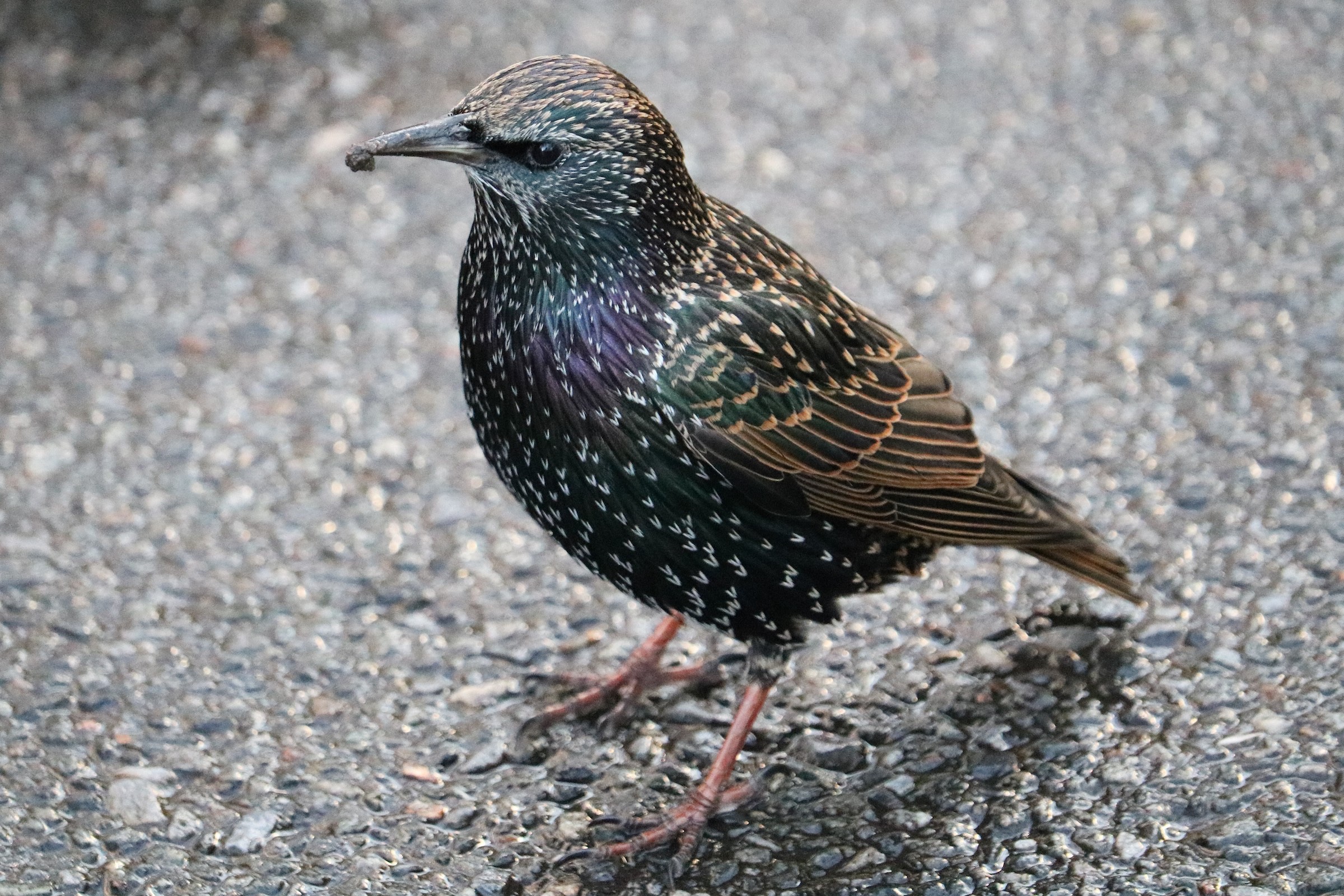
From fall to winter, starlings’ beaks are a dark brown-black color. In late fall, a starling walking on the street, usually in the gutters, appears almost as though it has no beak at all because it disappears into the blacktop. But even before the Valentine’s chocolate goes on sale—their beaks begin to change color.
A bird’s beak is made of bone covered with an outer sheath of keratin (like a fingernail) — called the rhamphotheca. In starlings, seasonal hormonal changes signal yellow-orange pigment molecules (called carotenoids), which cause the beak to change color as the breeding season approaches. The color change starts at the base and slowly makes it all the way to the tip — until the entire beak is a bright yellow color in spring. And when it comes to bird beaks, that’s really just the beginning.
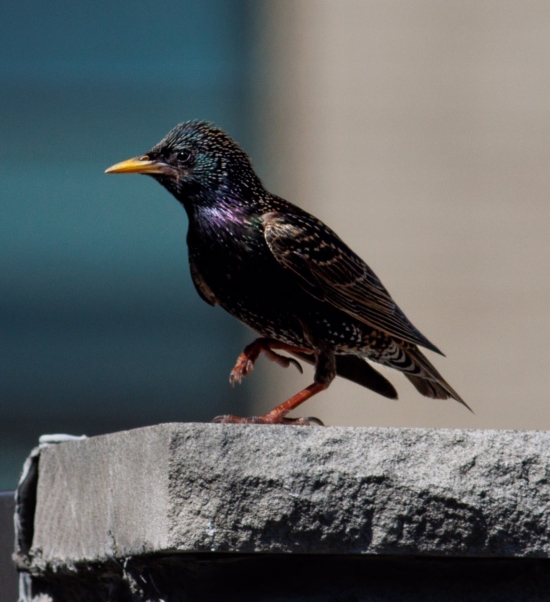
A beak is a miraculous multifunctional appendage which helps a bird eat, cool off, and impress mates. The only thing it doesn’t do is sing. Starlings, and most birds, produce sounds with their beaks closed, like a ventriloquist. Instead, the songs come from within.
Just inside Central Park, at 59th Street the other day, I saw some pigeons and starlings doing their take off, circle around in the low sky, and then land again behavior. This urban invasive interspecies aerial display on an otherwise gray day was almost beautiful. Then they all landed together in a patch of grass, and the starlings immediately got to work with their heads down, open bill probing to look for food. But the pigeons can’t do this, so they just moseyed around with their heads in the air. That’s where their niches diverged. Like a friend you brought to a party and then ditched as soon as you arrived.
Starlings have a uniquely strong muscle connected to their beaks, so they can insert their sharp (sometimes yellow) beak into the ground and snap it open and closed while it’s still in the soil. This is how they eat invertebrates like insect larva. You can often see them marching together in the grass, especially in spring, feverishly open-bill probing.
Springtime is the best time, but it seems to last just a few precious weeks full of dazzling daffodils, cherry blossoms blooming, soft yellow warblers stopping by, and gray starling juveniles learning to fly. Then summer comes in like a frying pan dropped by your upstairs neighbor, and it’s hot. But a bird’s beak helps them in summer too. A beak contains a complex network of blood vessels which allow for heat loss. Birds with larger beaks, like toucans, are experts as using their beak to cool off. The bigger the beak the more surface area for cooling. Sometimes starlings open their beaks to cool off, and they just keep it ajar for a while. They look like they are on the brink of saying something, but they don’t.
In our recent study, we found that invasive starlings in the U.S. have longer beaks than starlings from their native range in Europe. We explored many possibilities as to why this might be the case. Climate change didn’t fit because the beak change started around 1960, and it only occurred in U.S. birds, while 1980 is when the climate really began to warm, and the temperature change is greater in norther latitudes. Visit the American Museum of Natural History’s Climate Wall to see the climate data up close, it’s a fantastic interactive exhibit. It could be that when starlings came to the U.S. the summers were hotter than those in England, which could have favored longer beaks for cooling off. But we also found a substantial difference in the diet of U.S. starlings compared with those in their native range, and we suspect that had something to do with the change in beak length.
In New York City, our starlings often pop out for pizza crust, or a chicken leg in the bike lane — but in other parts of the country they eat corn that is meant for dairy cattle. This is not an anecdotal backyard observation, it a large-scale problem which involves thousands and thousands of birds and costs farms hundreds of thousands of dollars. So, I wondered if a longer beak would be advantageous for a starling eating the farm corn (which is usually in flake form, scattered among hay). We are still working on cracking this case.
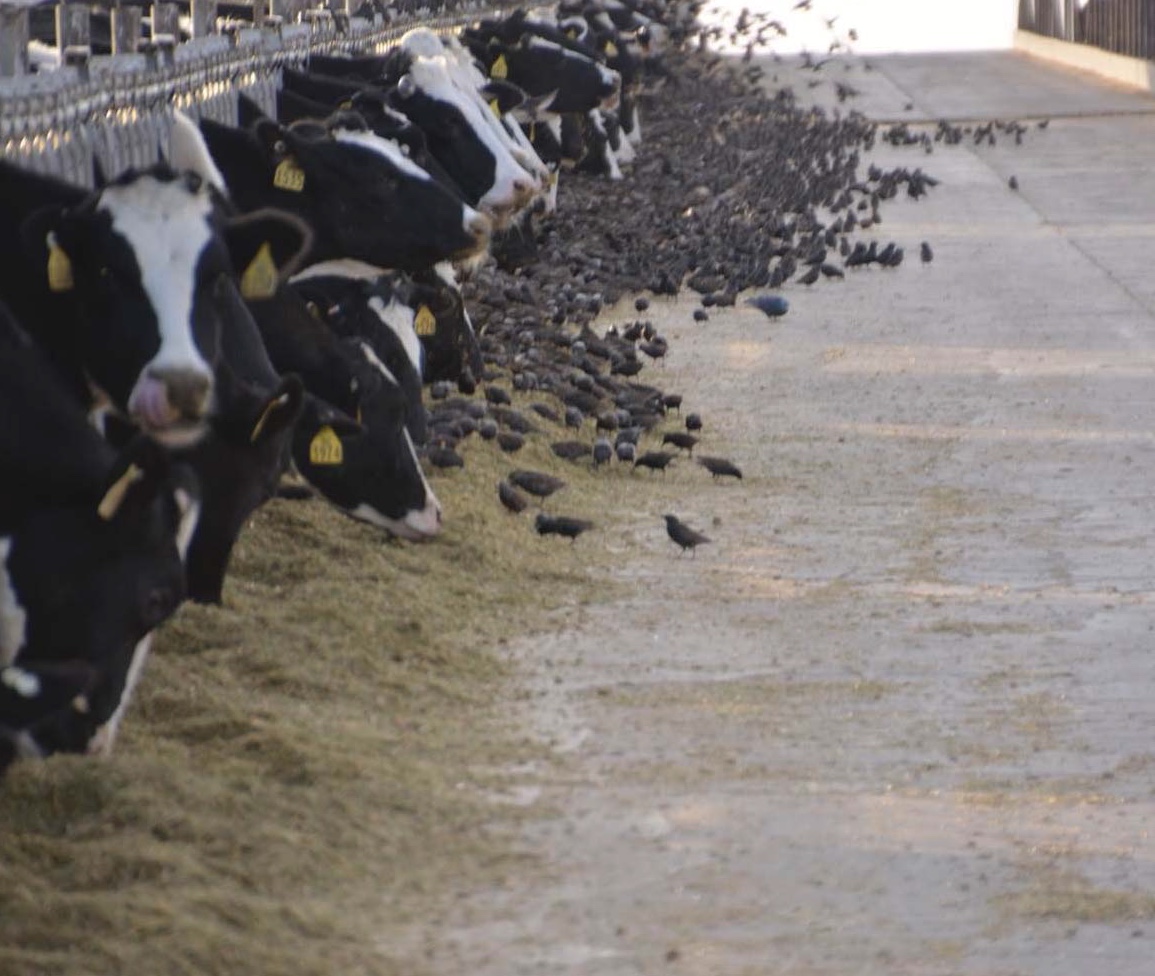
Starlings are invasive in the U.S., and I would be remiss not to mention that they are ecologically problematic, especially on farms, as seen in the photo. But because, in the city, we have bigger problems (trash, rats, and many other introduced species like daffodils, gasp!) I feel fine enjoying watching starlings. It does no harm.
This week on the Upper West Side you can see some starlings holding on to the black beaks of winter, while others have yellow beaks signaling that spring is coming. Out with the old, beak by beak. Here comes the sun.
Julia M. Zichello is an evolutionary biologist studying starlings, and writing a book about them for Columbia University Press. She lives on the Upper West Side.
Subscribe to West Side Rag’s FREE email newsletter here.





Very interesting and informative article. Thank you.
Thank you, Julia, for the very interesting — and well written — avian biology lesson,
What a wonderful and informative article!
I’m so happy to now know another visual sign of Spring. I loved reading this and will keep my eye out for starlings and their beaks!
Just fascinating! Loved this and learned so much. BTW, Mozart had a pet starling he loved deeply. When it died, he buried it in his back garden, had a stone there for it, and held a funeral procession! It’s said the bird could sing Mozart’s tunes.
Yes! and have you read the book “Mozart’s Starling”? It is a lovely book where the writer has a pet starling herself, and also goes on a historical journey to learn more about Mozart’s starling. https://www.amazon.com/Mozarts-Starling-Lyanda-Lynn-Haupt/dp/0316370894
Thank you Julia for your lovely observations of nature in the city. Looking forward to Spring AND your next article! 🙂
There was a starling with a bright yellow beak on my street this morning. I went to do my shopping with a lighter step — spring is really coming!
While I love the Rag for almost all of its stories, this is the kind of story that I love the most. Thank you, Julia!
We divide our time between the UWS and San Antonio, TX. This morning in San Antonio a starling with a yellow beak appeared on our deck. Because of your wonderful article I knew the significance of its beak color. Of course, that starling’s beak has probably been yellow for some time, since the temperature last week almost reached 90°!