

By Charlotte Robertson
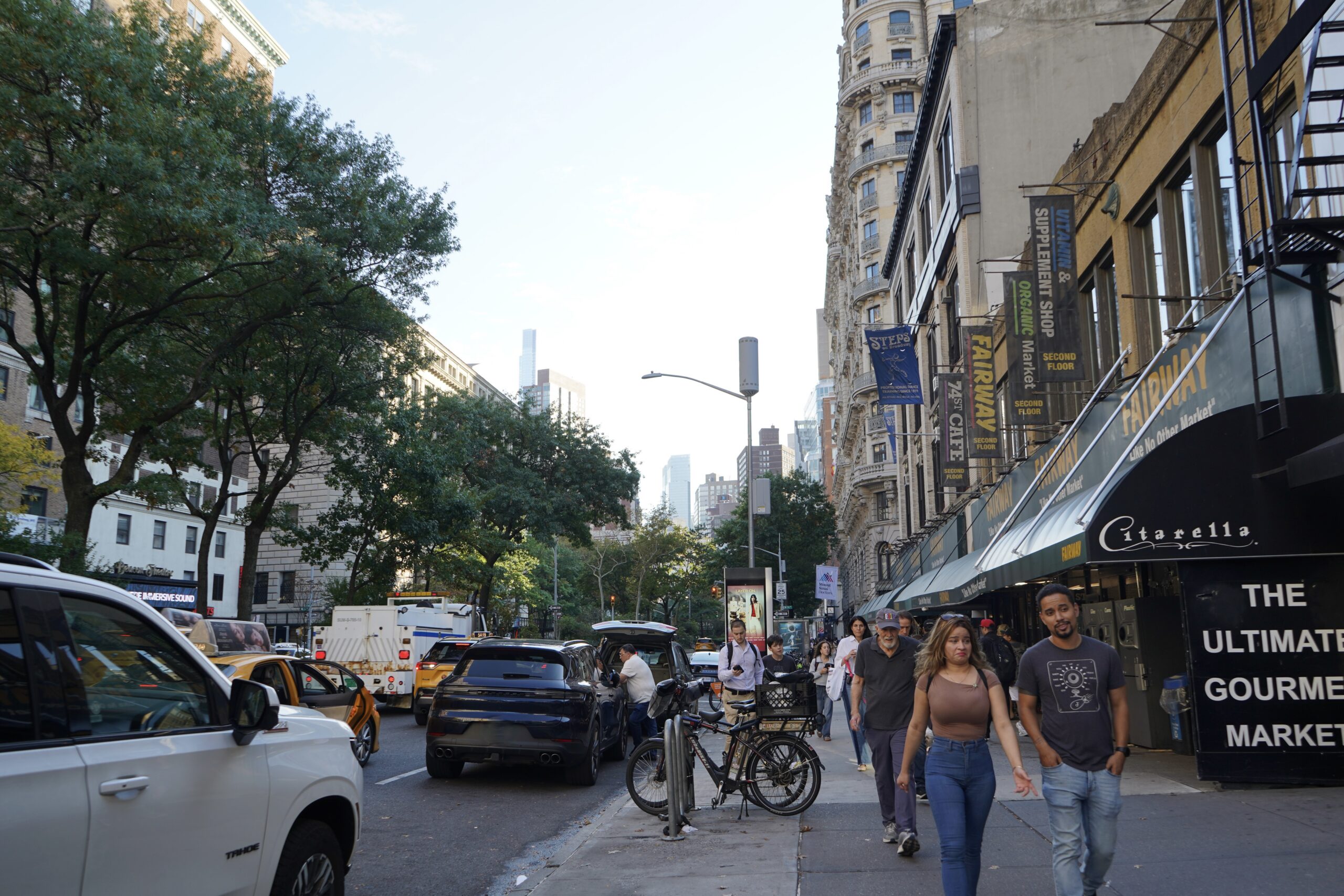
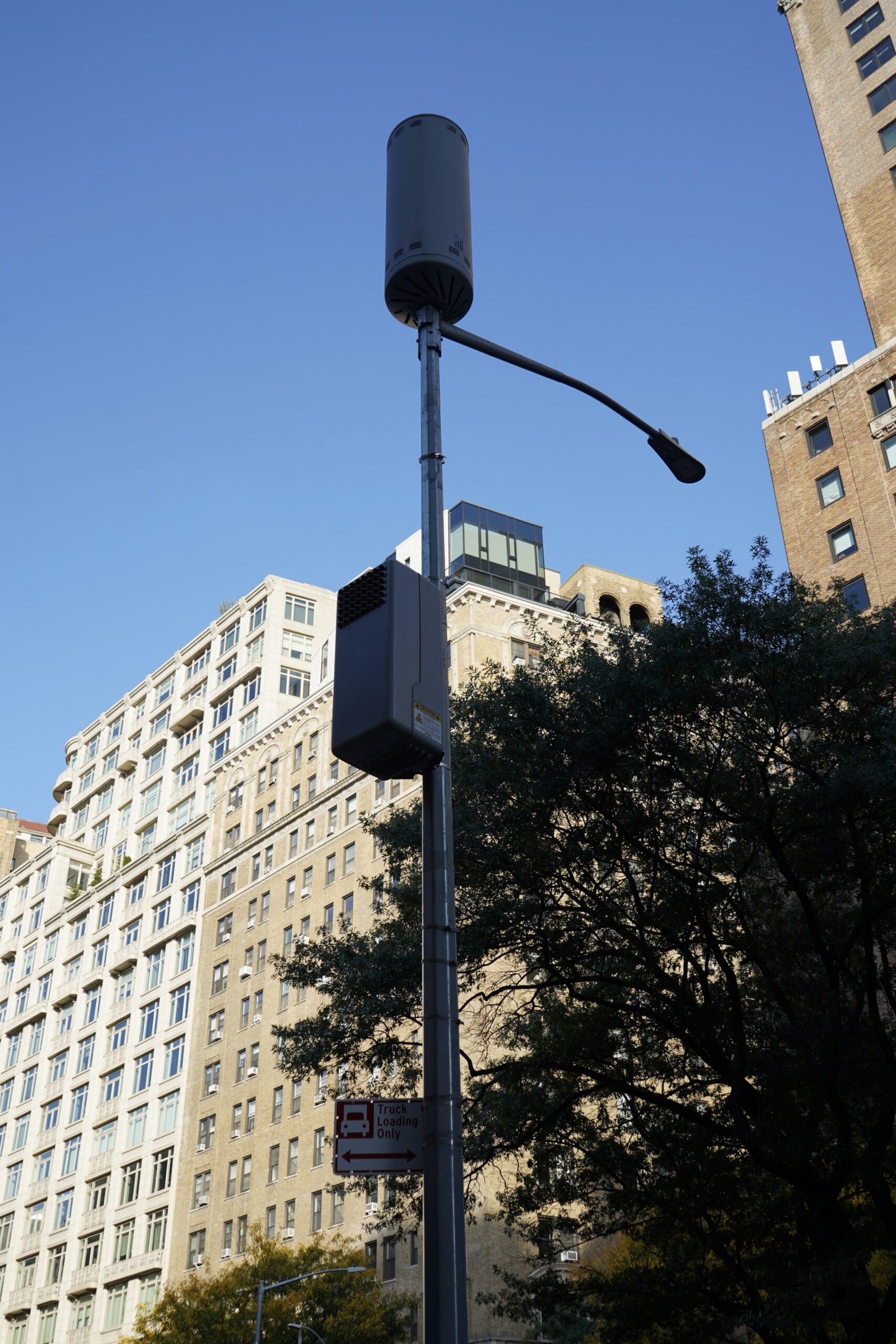
For the past six months, the curb management company, Automotus, monitored parking behavior on the Upper West Side using AI-powered cameras.
The temporary installation of two of the company’s “CurbSight” AI cameras along Broadway between West 74th and 75th streets ended this week, and the pilot’s results are now being analyzed by the New York City Department of Transportation.
The company delivered a presentation at the October 13th Community Board 7 Transportation Committee meeting. Margot Zuckerman, director of growth and strategy, said Automotus’ mission is to optimize public use of the curb and decrease traffic congestion. “I’ll just speak very personally, as a New York City resident. I would love to see commercial deliveries and double parking better managed.”
Automotus’ cameras analyze vehicle, pedestrian, and bicycle traffic in real time,” Zuckerman explained. The cameras can simulate loading zones and detect where vehicles park, allowing for an eventual automated payment system that, if adopted, could charge vehicles for time spent at the curb and penalize traffic violations.
During this pilot program, no tickets or fines were issued.
“The curb is one of the most contested and competitive public spaces in the city,” said Andrea Fondulas, a community organizer at StreetopiaUWS, in an interview with West Side Rag. “Automotus is a scalable resource to help solve things like double parking.”
Automotus, which declined an interview with West Side Rag, advertises its “computer vision” — a subfield of artificial intelligence that allows machines to not only capture, but interpret visual data — as first-of-its-kind technology. In effect, Automotus “monetizes” the curb, with its capability to send automated pay-by-the-minute invoices and citation mailings.
The Broadway block between West 74th and 75th streets was chosen for Automotus’ pilot program because of its retail concentration. Home to the Fairway Market flagship, the curb is often crowded with loading vehicles. And since launching “Fairway Now” with Instacart in 2023, which promises grocery delivery in 30 minutes, the presence of delivery cyclists has increased — the city even installed new bike racks in front of the store. The curb is shared with Citarella, which also relies on frequent truck shipments for fresh fish, produce, and meat.
“Everyone on the Upper West Side has had the experience of a grocery truck loading out of a travel lane, because people will just park in the loading zones long term,” said Sara Lind, co-executive director at Open Plans, in an interview with West Side Rag in an interview with the Rag. “Loading zones are not serving the function they’re meant to serve, which camera-based enforcement could fix.”
Automotus’ New York pilot has generated little press since its launch. The company’s press release was not published until August, four months after the cameras had been installed. NYCDOT declined to comment on specific questions related to Automotus, but Press Secretary Vincent Barone pointed out, in an email to West Side Rag, that the city has used computer vision sensors to monitor streets in the past.
In 2023, NYCDOT piloted 12 sensors from VivaCity, which mapped street activity in four boroughs. This past June, they were installed at an additional 80 locations. But, while data collected from VivaCity can be used to reform street safety policy, Automotus can also issue automated pay-by-the-minute invoices and citation mailings.
The city does not yet have authorization to implement Automotus beyond data collection, Lind explained. “Open Plans has an active campaign to try and get that authorization from the state, but it’s slow and difficult getting Albany to act,” she said. The relevant bill, S8665, was introduced to the New York State Senate by Senator Julia Salazar (D, WF) on January 7 of this year, and is under review.
So far, Automotus has partnered with a variety of cities across the United States, reaching across New Jersey, Pennsylvania, Georgia, Kentucky, Nebraska, Florida, and California, among others. Automotus is used differently by different cities, from enforcing bike lane protections, to issuing parking citations, to creating zero-emission curb zones. A case study obtained by West Side Rag about Automotus’ “Smart Loading Zones” in Fort Lee, NJ, reported a 43 percent decline in double-parking after automated billing went into effect.
In her presentation, Zuckerman explained that Automotus’ baseline technology also allows cities to “layer” the use of their curbs throughout the day: “Maybe something is a loading zone in the morning, paid parking during the day, and a residence permit at night.”
With plan variety comes pricing variety, according to Zuckerman. The City pays for Automotus’ hardware and software separately, on a subscription-basis, which changes according to services used.
NYCDOT did not comment on a budget for Automotus.
As for privacy concerns, Automotus claims to be “private by design.” Faces are blurred and only “relevant” license plates are recorded. Everything is processed on the cameras themselves, and data cannot be subpoenaed, as footage is deleted typically after 12 hours, as laid out in the CB7 presentation.
“Have you provided any of these reports to [CB7]?” Upper West Sider Daniel Eldridge asked at Tuesday’s meeting. Zuckerman said that releasing Automotus’ collected data to the public relied on NYCDOT’s decision. “I appreciate hearing about it,” Eldridge said, “But I’d like to actually see some of this [data] on your website or elsewhere.”
For now, the Automotus pilot cannot expand, regardless of its data collection results, until the bill in the Senate is passed into law..
Subscribe to West Side Rag’s FREE email newsletter here. And you can Support the Rag here.














Would love to see some order brought to our streets.