
By Tracy Zwick
The Upper West Side’s least splashy major museum has launched one of the season’s most powerful shows. “Locating Girlhood: Place and Identity in Early American ‘Schoolgirl’ Art” at the American Folk Art Museum introduces visitors to artists as young as eight – white, indigenous and black schoolgirls – who were making images of American places before academic movements like the Hudson River School began.
When I was a graduate student in art history, the catechism was that American landscape painting emerged in the 19th century, mostly through the work of adult male artists. The nearly 100 objects in the AFAM show –needlework pictures, samplers, maps, watercolors, painted furniture and other decorative works— tell a far more interesting story.
These works, mostly in homespun media like fabric and thread, are positioned not as quaint exercises in what Gen Z may consider grandmacore. They’re demonstrations of young women observing, representing and drawing meaning from the places and situations in which they found themselves.
Emilie Gevalt, one of the show’s co-curators, talked at a preview earlier this week about girls working “under the tutelage of women” to portray their worlds, often literally.
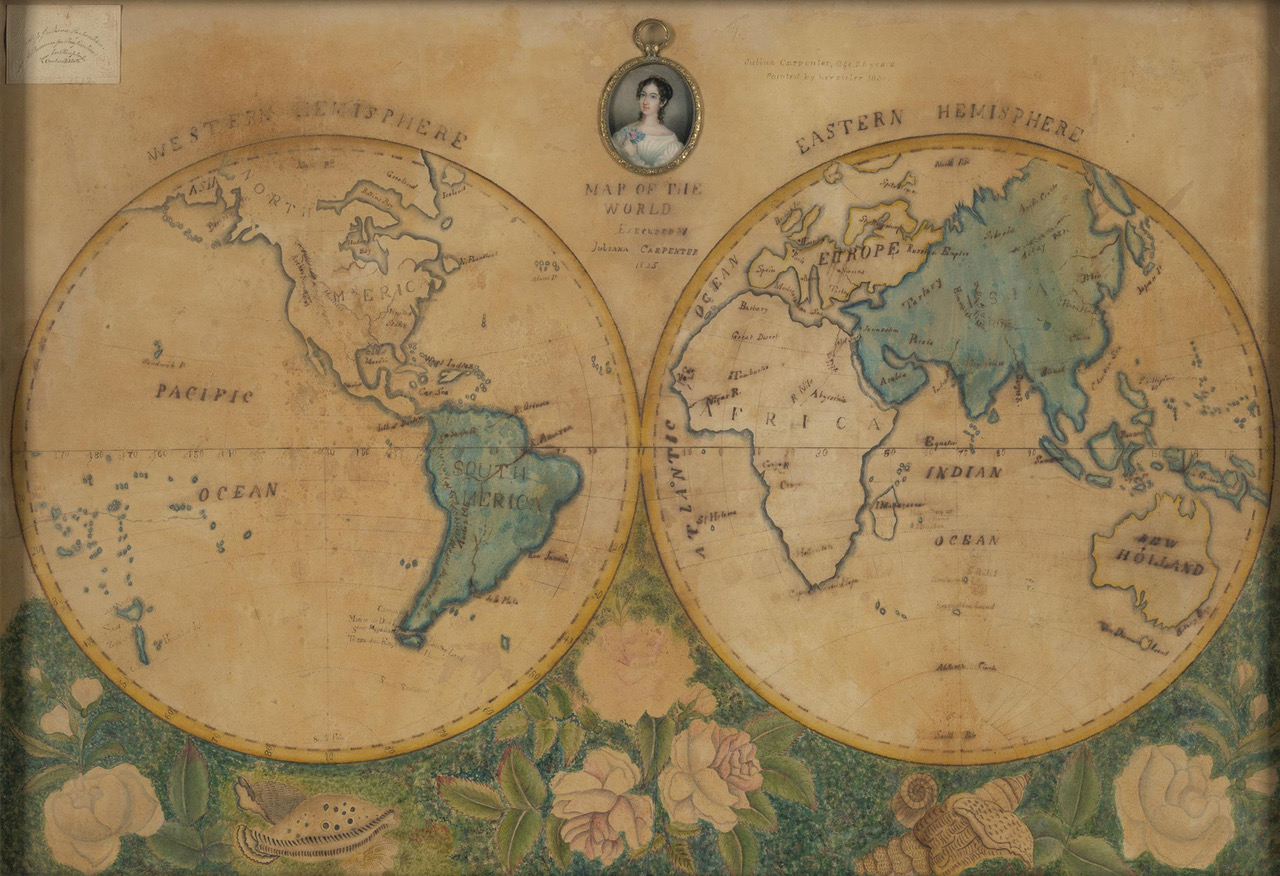
Fifteen-year-old Julianna Carpenter’s 1825 “Map of Two Hemispheres” is a rare school project – a watercolor that shows the two sides of the globe, surmounted by a miniature portrait of the artist, rendered by her sister. “At this time girls were being introduced to geography,” Gevalt explained. “With education reform, it was newly considered an appropriate topic for girls.”
Faith Trumbull, older sister of well-known painter John Trumbull, studied as a child under Elizabeth Murray, a teacher as well as a successful businesswoman who sold silk and fabrics. Trumbull was a tween when she used those materials to make her shimmering 1754 “Needlework Picture,” a landscape that’s in the exhibition’s first gallery.
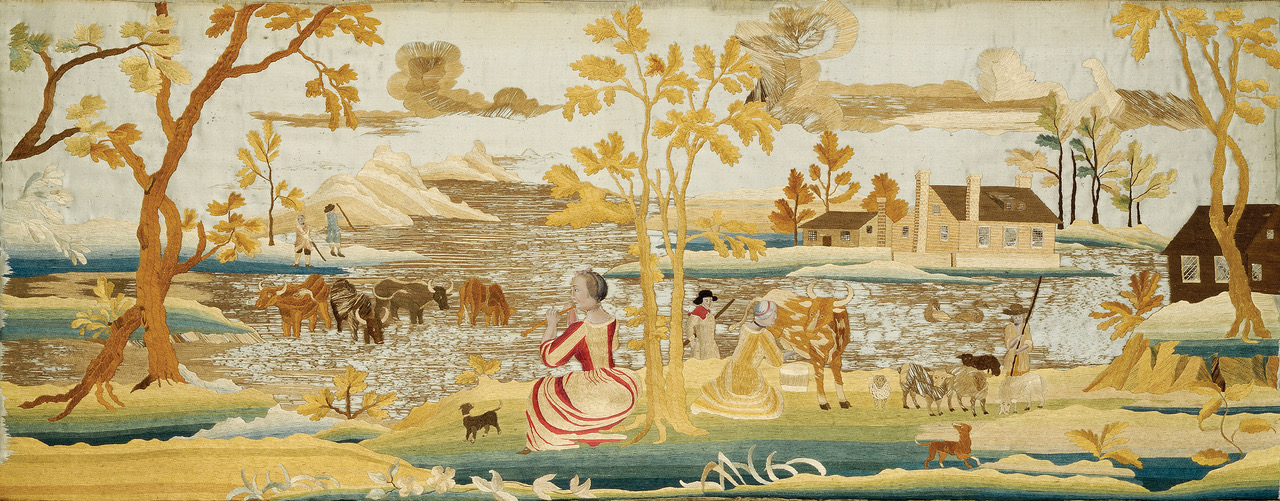
It shows wide open expanses at the left, then fills them in, as if moving forward in time, with colonial homes and figures as it moves across a horizontal field. The work hung in Trumbull’s family’s living room, and served as an inspiration for John, according to Gevalt.
Standout work by indigenous and black schoolgirls is in a nearby, raised gallery. “Early American needlework is thought of as an elite white practice,” Gevalt explained, “but after the revolution into the 19th century we start to see education opening up to middle class girls and others.”
Indigenous education included mission schools, “which we often think of as enforced and even places of violence,” said Gevalt. “But I spoke with a Choctaw Nation scholar who said they invited missionaries into the schools to prepare girls for lives among white communities. She sees this as a moment of agency.”
Gevalt explained there are very few extant African American “samplers” – pieces of cloth on which a technique is practiced or technical skill demonstrated. AFAM has seven in the show.
An 1818 “Sampler” by 8-year-old Miranda Robinson includes the letters of the alphabet, numbers, and varied stitching techniques – “some of the first things you needed to learn as a girl,” said Gevalt. It also identifies her school, named for educator and abolitionist Clarissa Lawrence.
“These are really political tools as I see them,” Gevalt explained. “They look like the work being made by white girls at the time, but that was part of the goal – to say we can do this and we are using this needlework to claim our place in American society at a time when there were no end of efforts to exclude black students and black families.”
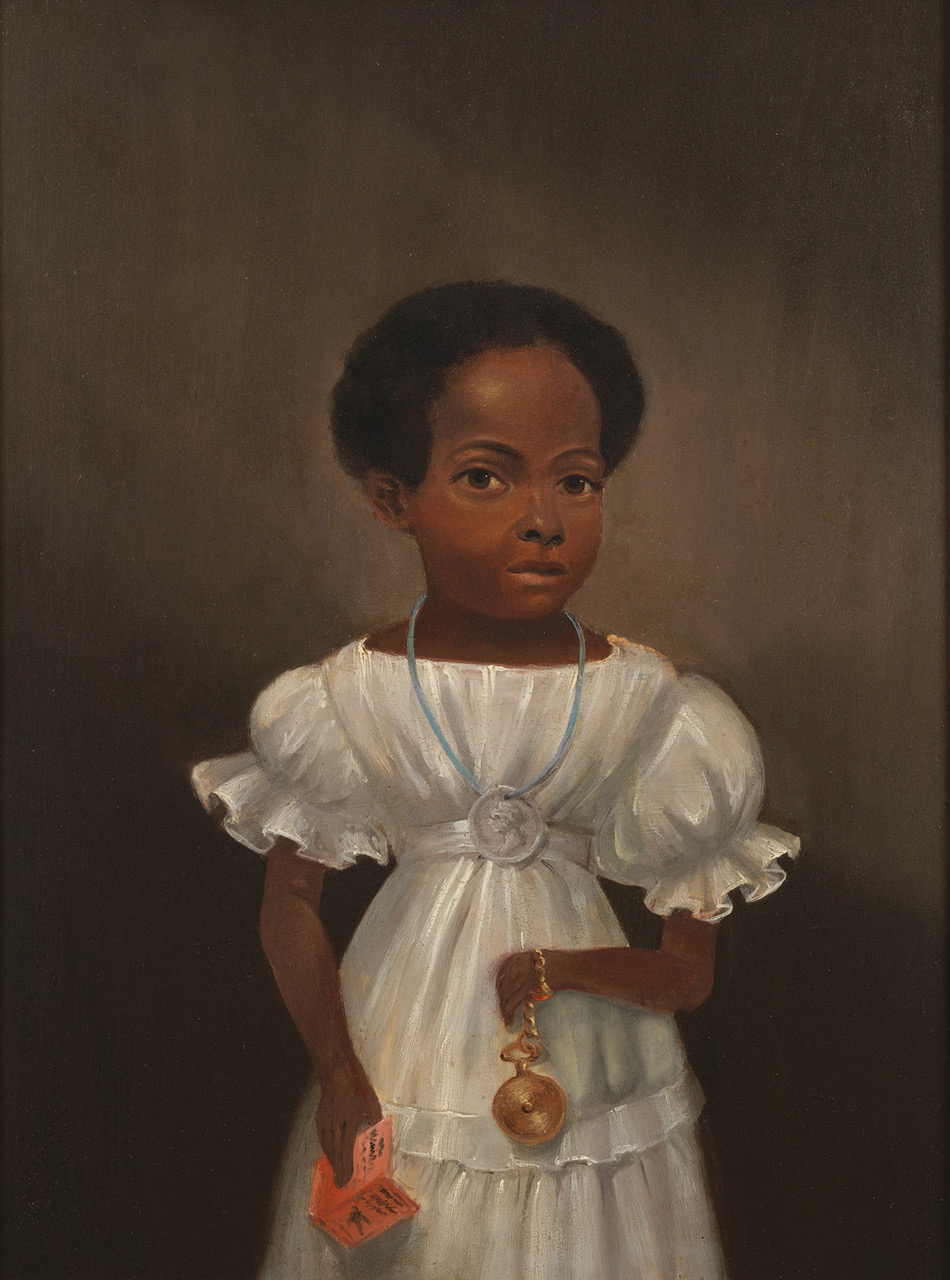
The gallery also holds a rare 1840 oil portrait of a young black girl. “Very few portraits of African Americans exist at this time,” said Gevalt. The girl is depicted with a gold watch and reading material – which suggest literacy and prosperity. She’s wearing a merit badge around her neck, “though these were often denied to black students,” Gevalt explained.
Nearby is a striking 1844 oil portrait of an older seated white woman, Maria Birch Coffing, and an unnoticed young black woman, Jane Winslow, holding an open door to her left. Winslow had come to live with the Coffings as a child, after her parents died, and worked for them for decades.
“We wanted to represent all of those unseen black girls and women,” said Gevalt, “who were often making it possible for white women and girls to do more fancy needlework.”
AFAM is offering public programs in conjunction with the exhibition, including “Embroidery Night School,” a hands-on, artist-led embroidery workshop on November 12th.
- The show opened on October 9 and runs through February 28, 2027.
- The American Folk Art Museum is at 2 Lincoln Square (Columbus Avenue & West 66th St.)
- Open Wednesday – Sunday 11:30 a.m. to 6 p.m.
- Directions and hours here
- Always free!












YES!