
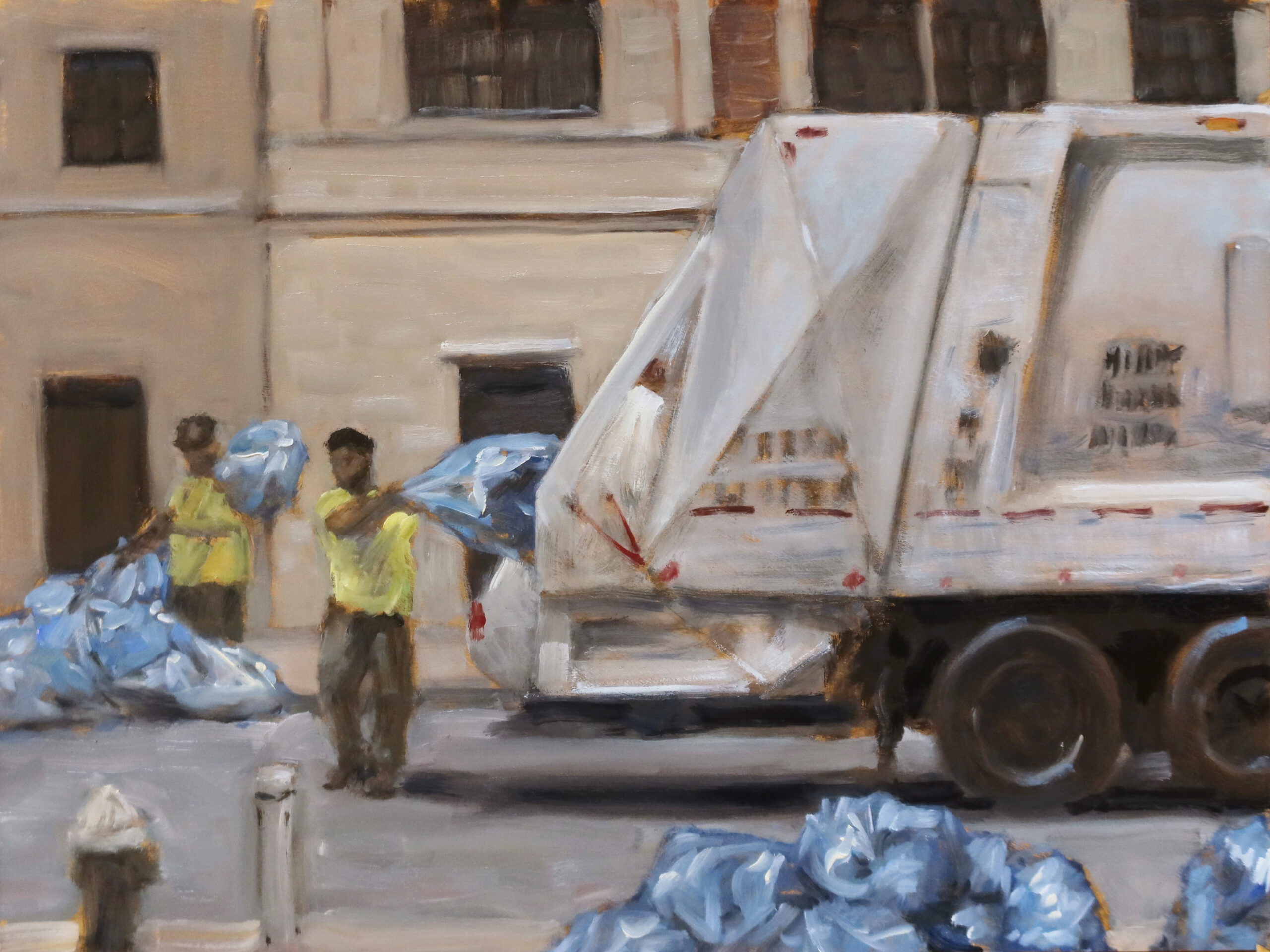
 Painting and essay by Robert Beck
Not to go full back-in-my-day on you, but in the pre-plastic era, trash cans were galvanized steel. Everybody had them. Part of the morning garbage-collection sonata was the clatter-crash of those cans being tossed back onto the yard or driveway, banging against each other and sometimes rolling into the street. Over time, they transformed from cylindrical to semi-oval to really bent up while the lids remained round, making it harder and harder to get them back on. When the bottoms rotted out or the handles broke, you got new cans.
It was simple. The kitchen garbage went in a paper grocery bag or maybe straight into the can, with anything else you wanted to get rid of. Anything. The inside of the can was pretty grody. You didn’t worry about recycling or hazardous materials. It was toxically convenient.
Some of the out-of-sight, out-of-mind crowd will disagree, but we are way better off with recycling, composting, clean water, and attention to hazardous materials. I grew up along a major river that was dead and disgusting until laws that controlled disposal were enacted. Now it’s beautiful again, and the people who oppose that kind of legislation are buying waterfront houses.
I have reflected over my adult lifetime on how society resembles our bodies. Look at a map, and it’s not hard to see the roads and railways as a giant circulatory system. I’ve watched the computer become critical to our everyday lives and act as a surrogate nervous system, and now it appears we are creating what, in somebody’s idea, is a thinking brain. It’s not clear where the people doing that get the authority to be the agent for the rest of us, but they are bringing with them all the scruples Free Enterprise requires. The cost in power generation, environmental damage, creative suppression, individuality, and loss of jobs is enormous, although some folks will do very well. If this is intelligence, it’s got a big mental health issue.
(Clears throat) Sorry, I got a little off-track there. Back to my society-as-a-body analogy. The role of digestive system is played by the Sanitation Department. We consume a tremendous amount of stuff, and it all has to go somewhere.
This painting depicts a small slice of that journey, but it’s where awareness of the process ends for most of us. Those piles of black and clear-blue bags on the sidewalks. The trucks blocking traffic. The manual labor (I wouldn’t make it to the end of the block). The removal part is in clear view, but then the bags are whisked away to … somewhere.
The recycling, I don’t know. The trash, maybe to an incinerator that makes steam and generates electricity. That would be nice. More likely it’s shipped by boat, train, or truck to an open pit in a foreign land, like Ohio, or a Carolina. Out of sight. Raise your hand if you know where that plastic take-out tub of potato salad in your fridge ended up —the one that was too old and disgusting to clean out for recycling, so you just dropped the whole thing in the trash. Me neither. But that reminds me; I have to pick up some more on the way home tonight.
Note: Before Robert Beck started West Side Canvas, his essays and paintings were featured in Weekend Column. See Robert Beck’s earlier columns here and here.
Subscribe to West Side Rag’s FREE email newsletter here. And you can Support the Rag here.







For a detailed description of where NYC trash goes and what happens to it read Manhattan Solid Waste Advisory Board’s excellent detailed description
https://www.manhattanswab.org/nyc-waste-exports
As for your dirty plastic potato salad container please rinse it out and toss in plastic recycling. Environmentally speaking, the amount of plastic that really gets recycled though is 6-9%. Want to be more on the pro planet side of things? Bring your glass or aluminum reusable container to the grocers and deli and ask them to fill it with ready made food of your choice.
I encourage the West Side Rag to offer more stories about residents efforts to make sustainable choices. After all, the earth doesn’t need perfection just people who care consistently.