

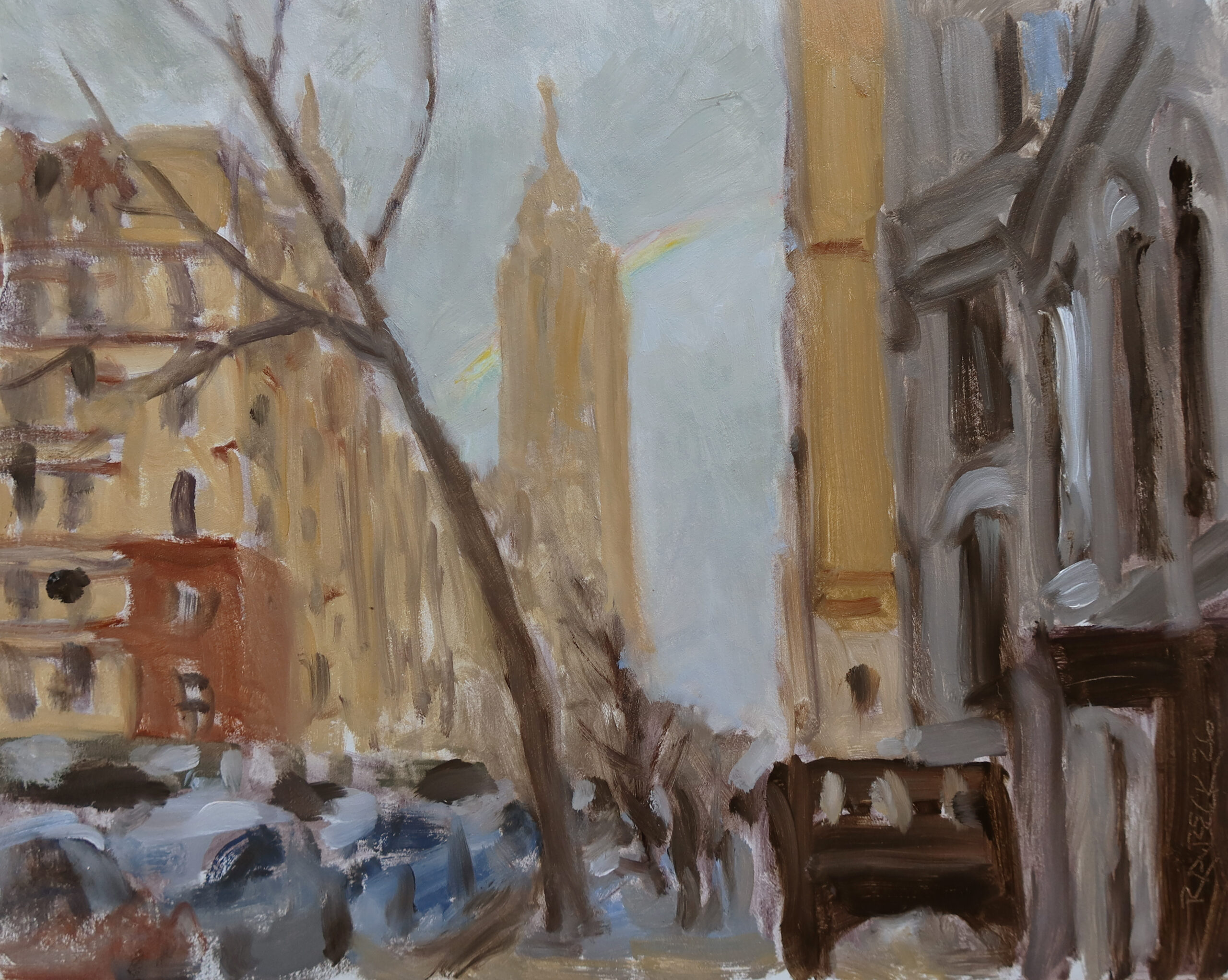
Painting and essay by Robert Beck
I’m a big fan of meteorological phenomena. I even love how the phrase feels as it tumbles out of my mouth. There is so much to choose from: sun, rain, snow, fog, clouds, skies in shades of blue, green, and gray (and now orange).
Everyone likes a good sunset, but the big crowd-pleaser is a rainbow. I think part of that is because it’s unexpected. Every language on earth has its version of “Look, a rainbow!,” and they all come with a second take.
There is nothing like it. Sunrises and sunsets are meaty, vivid, and sometimes vulgar, but rainbows are ephemeral and elusive. They have a supernatural holographic quality; it’s there, but not really. You could put your hand through it if you could only get close enough. Some cultures think of them as bridges to the gods. Evidently the gods don’t want just anybody visiting them.
The rainbow has a strong visual signature, with its curve and spectrum of colors. In less-informed times, they were portents of events, as were eclipses and volcanoes. They were convenient opportunities to support a belief or agenda. Good for the prophecy business.
We learn about rainbows early. They are default happy-child decorations, along with sailboats, and unicorns. We draw them as soon as we can get our pudgy fingers around a crayon. You don’t have to get the colors in the right order, or even have all of them, to get the idea across. Just an arc. But that’s not what the real thing looks like. It’s not scribbled on paper, cut out with scissors, and pasted on something blue. As I’m sure you suspected, there’s science behind it.
A rainbow is deconstructed sunlight, reflecting back to you from water drops. The specific rainbow you see is because the sun, your head, and the moisture in the air, are all in the right position relative to each other, with the sun behind you and the storm in front. You see them after the storm has passed, but you could see it coming too. Since the center of the rainbow circle is directly opposite the sun (Yes, it’s a circle—you just see the top part), the sun has to be low for us to see the rainbow — early or late in the day. It requires a lateral view, which can be tough in the city as buildings get in the way. Your rainbow could be there right now without you knowing it. They depend a lot on you, which makes them very personal. Better than unicorns, in my opinion.
When the light enters the water drop from your direction, it spreads into colors, like when it goes through a prism. Then it’s reflected back to you by the far side of the drop. The rainbow arc in the sky appears with red on the outside, and blends through orange, yellow, green, and blue to violet on the inside. People on the Upper East Side don’t see rainbows because they don’t believe in science.
If the conditions are right, and some of the light bounces around inside the drop a second time, you might see a second rainbow. These cause great excitement. That second bounce comes out at a different angle, so there are different geometries involved. The second rainbow appears outside the first, and the order of its colors is reversed. Those colors are dimmer overall because making second rainbows requires more effort. It’s hard work dragging around those extra pots o’ gold.
* * *
See more of Robert Beck’s work and visit his UWS studio at www.robertbeck.net. Let him know if you have a connection to an archetypical UWS place or event that would make a good West Side Canvas subject. Thank you!
Listen to an interview with Robert Beck on Rag Radio — Here.
Note: Before Robert Beck started West Side Canvas, his essays and paintings were featured in Weekend Column. See Robert Beck’s earlier columns here and here.
Subscribe to West Side Rag’s FREE email newsletter here. And you can Support the Rag here.





LOVE this painting.
Perfectly captures the awe I feel when I catch a rainbow! Thank you for sharing 🙂
I still don’t understand how rainbows 🌈 are formed but I always feel happy on those rare instances when I get to see one, even in a lovely painting.
Lovely story but weird line about UES science deniers.”
Agree—the number of scientists in those research labs around the hospital and universities on the UES must be the most in the region—what in the world does this line mean?
I too don’t understand the line about UES science deniers. UES, where there are more health care professionals per square block than most places, lives and breathes science…….24/7. And our rainbows are inspiring. My granddaughter would love to share one of her 300 paintings of them!
Please post one!
Thank you for your wonderful little essay on a fun subject. I love your painting. Your abstract painting has a childlike quality. Rainbows are a marvel of naturel. I have seen a couple in my lifetime. Now the only rainbows I get to see are from my Rainbow Maker which are prisms I attach to my window. When the light is right it makes rainbows jump all over my apartment walls.
UES science deniers!! **chef’s kiss
Nice clear explanation — and “people on the Upper East Side don’t see rainbows because they don’t believe in science” is such a razz! (Obviously, people working in the medical centers do champion science.)
To remember the colors–Roy G Biv