

By Gus Saltonstall
Gail Buchwald stumbled upon the Central Park turtle issue.
She was out for a stroll earlier this year when she noticed a man feeding turtles at The Lake in Central Park.
“I grew up with a tortoise as a pet. I now have different feelings about exotic animals as pets, but I was able to learn as a kid about turtles and tortoises,” Buchwald said to West Side Rag in a phone call. “So, I came to love turtles. I’m also not a fan of people feeding wildlife, especially human food, so I had a ‘friendly altercation’ with the man.”
While the man could not be completely talked out of the action, Buchwald decided to run over to a nearby pet store to at least get turtle food, which he accepted. The pair ended up sitting together.
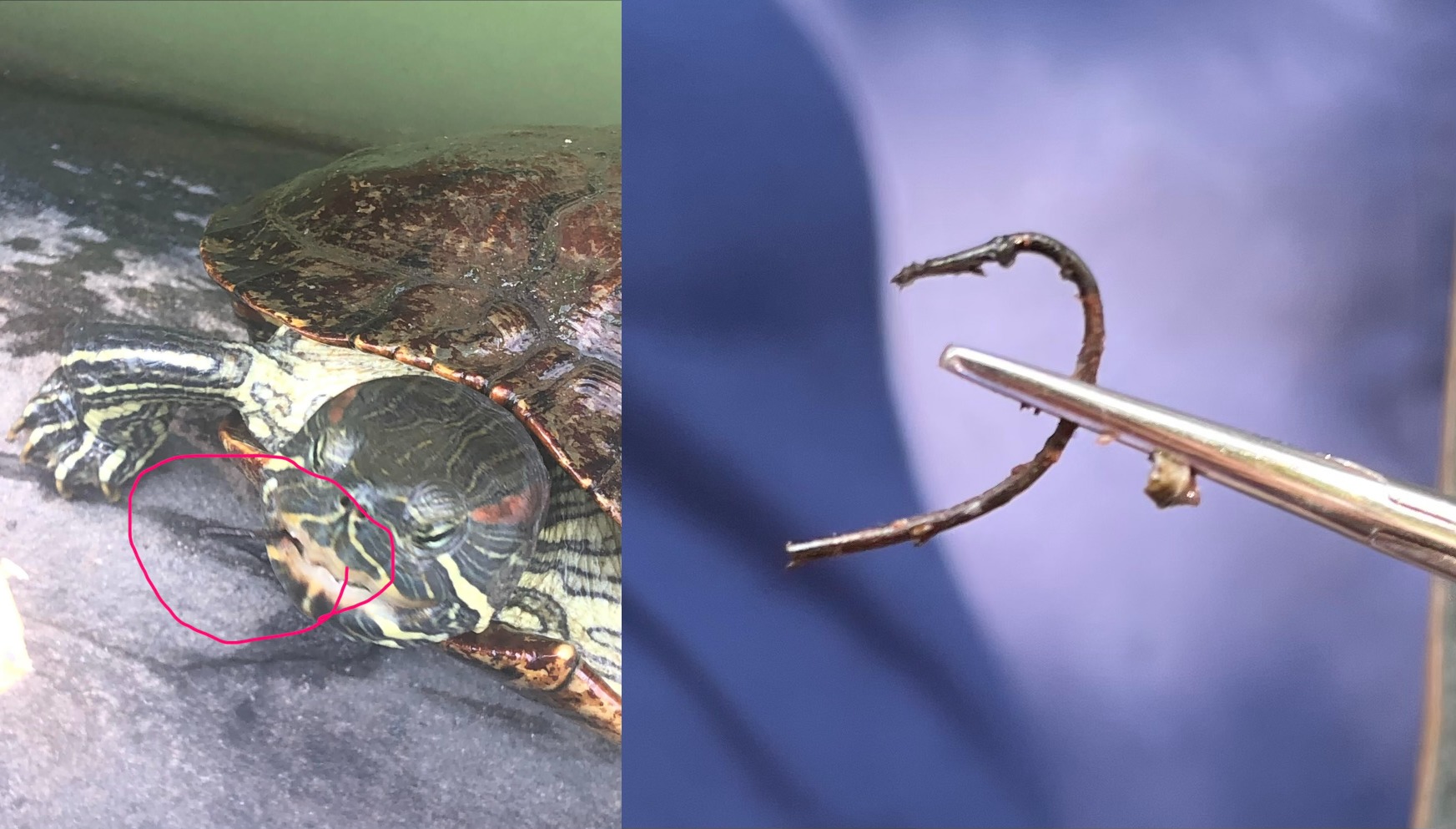
“He pointed out that one of the turtles had a big rusted hook protruding from its mouth,” Buchwald said. “He attempted to remove the hook, but could not. So, I went up to the Wild Bird Fund and asked them if they would be able to remove a hook, and they said yes.”
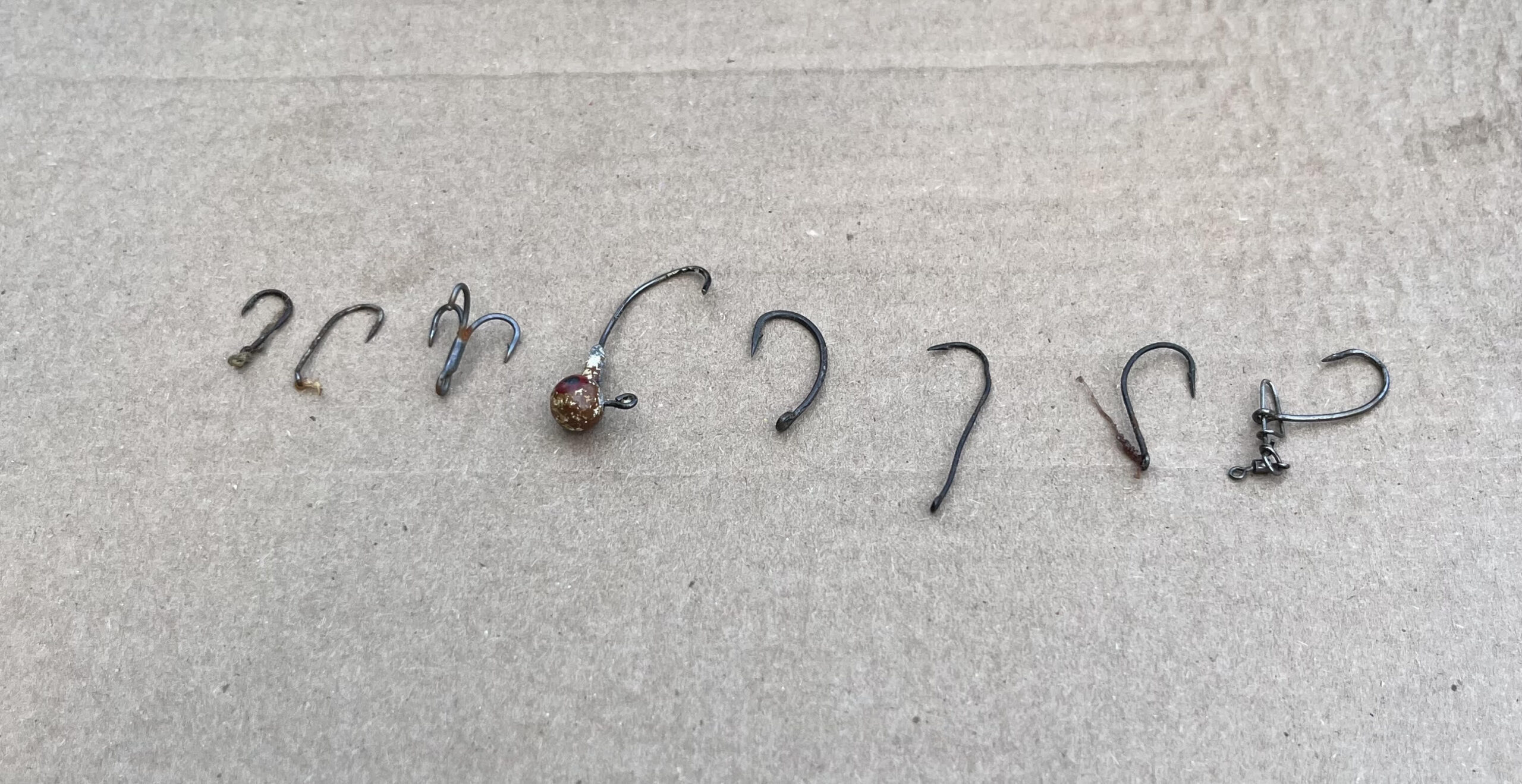
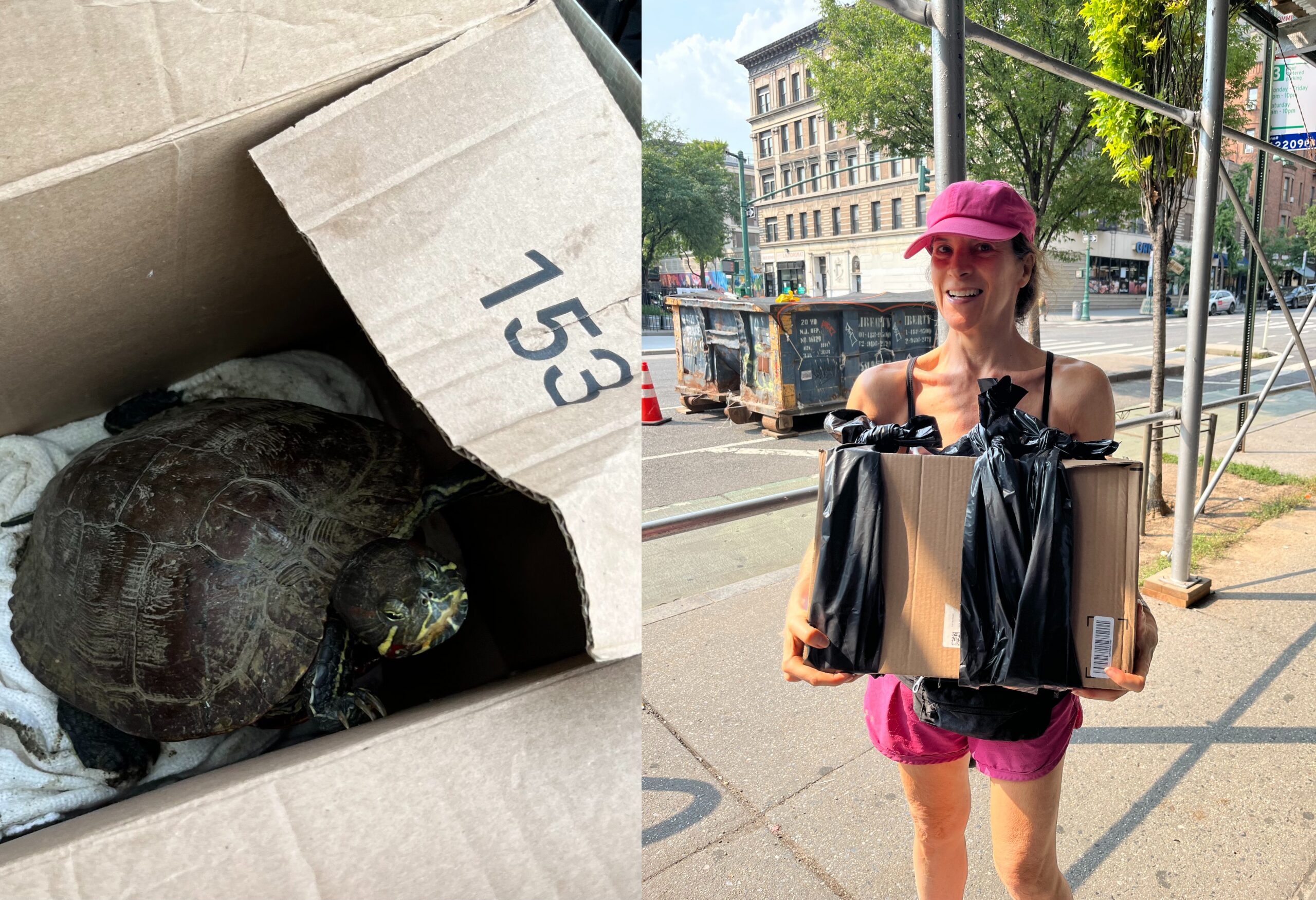
Buchwald grabbed a box, returned to The Lake, and transported the turtle to the wildlife rescue organization on Columbus Avenue, between West 87th and 88th streets. The animal professionals were able to remove the fishing hook and also told Buchwald that a Parks Ranger recently brought in three turtles from the Harlem Meer in Central Park with fishing hooks also embedded in their mouths.
“That is when it became clear to me that this was a real problem,” Buchwald told WSR.
When Buchwald got back to The Lake to return the turtle, a teenager showed up at the same time with a fishing rod.
Fishing is not illegal in Central Park. You can take part in catch-and-release fishing at most bodies of water in Central Park, including the Harlem Meer and The Lake. What is prohibited within the park, though, is barbed hooks, which lodge into the mouth of anything they snare, including turtles.
Barbed fishing hooks have a small, backward-facing metal point behind the tip of the hook that latches onto the fish, or whatever else it might snare, whereas a barbless hook has a smooth shaft that relies on puncturing the fish. Barbed fishing hooks make it easier to reel a fish in, but also increase the chance of the fish being damaged in the process.
“Central Park guidelines list that you cannot use barbed hooks, but they don’t have anyone enforcing it,” Buchwald said. “And let’s put it this way, I’ve never seen someone fishing in Central Park not using a barbed hook.”
Catherine Quayle, the communications director at the Wild Bird Foundation, confirmed to West Side Rag that the organization has received eight to 10 turtles with fishing hooks in their mouths in 2026, and five to six of them in the last two months.
She added that almost all of the turtles came from Central Park.
“We see illegal hooks all the time,” Quayle told the Rag in a phone call. “First I would say, it’s not just turtles. We receive ducks, herons, gulls, swans, all of the wildlife in Central Park and other parks can get hooked on discarded fishing tackle, and they do. It happens all the time. It’s very, very common. We’re not opposed to fishing. Fishing is a great way for people to enjoy the park, but it needs to be either better enforced or there needs to be better education about how to handle situations where you hook an animal.”
While enforcement on the barbed hooks is important, Quayle pointed to a different component of fishing as where she’d like to see stronger oversight.
“The proper disposal of fishing equipment,” she said. “Sometimes, it is just left in the water. People frequently find fishing lines with hooks on it tangled around trees, or people not disposing of their fishing tackle properly. There are times when people who are fishing get their hook caught on something, and then just cut the line. That’s when we get into really bad problems.”
When reached for comment, a Central Park Conservancy spokesperson wrote, “The Central Park Conservancy encourages everyone fishing in the Park to follow all applicable regulations and practice safe, responsible catch-and-release fishing. More broadly, we ask all Park visitors to leave the Park better than they found it—which means properly disposing of fishing line, hooks, and other waste, and giving wildlife the space and care they need to thrive.”
The spokesperson reiterated that barbed hooks are prohibited within the park, but that enforcement, licensing, or ensuring compliance with fishing hook requirements fall under the jurisdiction of the New York State Department of Environmental Protection.
Buchwald spoke to a staff member at a veterinary practice that specializes in exotic animals on the subject of whether turtles feel pain.
“The vet staffer said, ‘Oh, they feel pain. They do not like injections,'” Buchwald said. “When you think about the tiny size of a needle from an injection, and compare that with the size of a hook, and then add to that gravity when a turtle is being reeled out of the water with all of its body weight being carried in the roof of its mouth by that hook. I think the pain is quite remarkable. Turtles do feel pain. And I would like the public to have a better understanding of that.”
Subscribe to West Side Rag’s FREE email newsletter here. And you can Support the Rag here.





good for Buchwald (and the turtle)!
Scientists have known for quite a while that turtles — as well as fish — feel pain. There is no way that even “catch and release” is “responsible” or humane behavior. (Imagine having someone deliberately catch you in your mouth with a barbed hook that pierces the skin, then removes it, tossing you back, and feels good about themself for doing so.)
Should be signs posted everywhere. Probably people catching them & eating them!
Don’t know what signs will do w/people who don’t seem to care.
The types of turtles in the ponds in Central Park are not edible (unless one is desperate, I suppose). They are also not big enough. They are primarily pets that have been “re-wilded.”
Yes! I know of a neighbor who did just that.
No. Both common snapping turtles (Chelydra serpentina) and spiny softshell turtles (Apalone spinifera) can be found in Central Park. I’ve seen them personally.
Most are red eared sliders which are not a species native to New York.
Kudos to Buchwald.
The question is why catch-and-release, a cruel and barbaric practice, with or without barbed hooks, is permitted at all in Central Park.
Catch and release is not cruel if done correctly. For some fish, barbed hooks are not allowed.
Wow so proud of my amazing aunt!
Thank you Gail and thank you to the author for writing this important piece! Hope lots of people will read this and think twice!
I’m pretty surprised you can fish in the park—I don’t remember ever seeing anyone do it—can’t we evolve to just appreciate the wildlife that’s in the park without stressing it with catch and release—it doesn’t even sound like numbers are being controlled if it’s catch and release so let’s just let them be—poor turtle of course it feels pain—those barbs don’t give up easy
For those curious: https://www.centralpark.com/things-to-do/sports/fishing/
Apparently fishing is permitted in Harlem Meer, Central Park Lake, and Central Park pond (but not the turtle pond or the reservoir) .
The fish in the park are not “wildlife”. The ponds and lakes are stocked.
If a fish was stocked in an urban park and is now living freely in the water, most people would consider it a wild fish, although not necessarily a native or naturally occurring one.
Wow it’s stocked too AND you can fish—didn’t know any of this—still I don’t see any way to police the use of barbed hooks or all the other fishing debris like nylon fishing lines to hurt and entangled animals so maybe it should just stop
Causing such horrible pain, Trauma., and death to the lives of many. Think , think of what you are causing people!! This is brutal. Cruelty and carelessness. They also are causing ducks to loose legs and death. I can only hope this hooking is Stopped!! I love this woman for helping and getting the word out there. Have a heart . Thank you
Sure let’s ban fishing then and give inner city kids one less thing to do ……red ear sliders are a non native invasive species…….how about having designated fishing parts with just fish…and not 3 million red ear sliders ……don’t take fishing away from the kids … or would you rather they do drugs ………
It’s great when kids, especially kids in the city, fish. They’re creating a connection to nature. So stop slamming the activity – the real issue is proper technique and whether or not kids are being guided properly. If you want to see the change – be the change and get knowledgeable about the topic.
How many actual kids vs. adults ARE fishing? Are the kids fishing under adult supervision?
David: fishing or doing drugs????
I don’t think it’s an either/or equation.
Three cheers for people like Gail Buchwald who are making the effort and taking the time to advocate for the animals who are suffering at the hands of thoughtless and inconsiderate people. There’s loads of animal lovers out there but an extra thank you is due to people like Gail who are taking their time to do something about it. Thank you!
They should just ban fishing there, solve that problem.
Three cheers to Ms. Buchwald! Heroism in action! We need more people like her to be willing to have a conversation and take the necessary actions to make a difference. A really inspiring fellow New Yorker!
Thank you so much,Gail and West Side Rag. Last year while walking along the Meer by the Davis center. I saw a large turtle with just such a hook in its mouth. . I phoned the conservancy and the wild bird fund. I did receive a call back from the conservancy. Reading this article about what you have done makes me a bit more comfortable that something was really done for that poor turtle I saw in Central Park.
Thanks for highlighting one of the challenges facing turtles and other chelonians today. For more information about what is being done both at home and globally visit the TurtleSurvivalAlliance at turtlesurvival.org.
I cannot understand the logic – or justification – for catch and release fishing. If one is hungry, by all means, fishing for food makes sense. But just to catch (read: terrify, wound, and torture, essentially) a fish – or any other animal for that matter – for the ‘sport’ of it, feels … well … very wrong. What is the point, beyond willfully ignoring the fact that this is stressful, painful, and utterly unnecessary? Why do we allow that in our parks?
It’s on a par with fox hunting & bull fighting.
Evidently so kids will have something worthwhile to do instead of stealing cars or joining an enjoyable afterschool group.
If the NYS Department of Environmental Protection is responsible for monitoring compliance with the regulations on fishing all hope is lost. For years they have not regulated or followed up on compliance with the grocery store plastic ban law. Though compliance is pretty good at UWS grocery stores, compliance in Queens is near zero. DEP has been notified and do not respond. Closer to home, no oversight is being conducted for NYC’s 2023 Skip the Stuff law https://portal.311.nyc.gov/article/?kanumber=KA-03588
which requires all take out restaurants to not give out utensils or condiments unless customer requests them. Why does NYC pass environmental laws and not enforce them?
I’ve lived next to Central Park for nearly 40 years and have never seen as much as one sign explaining that barbed hooks are prohibited. That would be a good place to start.
Instead of banning fishing why not organize a free hook exchange. Barbless hooks aren’t that easy to find. Ban barbed hooks. Also dedicated waste recepticles for discarded tackle could be placed at the North end of the Meer where most of the fishing occurs.
Fishing is incredibly relaxing and it happens outdoors. Kids and adults experience nature when fishing whether they realize it or not. So much better than sitting around like a lump watching a screen.
I’ve given up fishing because I was harming the fish unnecessarily. But 10 years ago I caught a small bluegill and was reeling it in; suddenly a large pickerel (relative of a pike) jumped up and swallowed the bluegill whole. It thrashed around on my line untill a snapping turtle grabbed the pickerel tail first and started gobbling it down. This was still on my hook and line. I fought the turtle and suddenly the pickerel tore in half. The pickerel’s head with the bluegills’ head with my BARBED hook still stuck in it’s throat flew up in the air and almost hit me on the head. Please excuse my true shaggy fish story showing how tenacious those barbed hooks are.
How about requiring everyone who comes equipped for fishing in Central Park Lake to get a seasonal license for $5 or so? At the time the Central Park Conservancy should explain to the fishermen the rules such as not using bared hooks
While Depts dodge responsibility, animals Suffer. Patrol & Enforce!! Don’t wishfully depend on the “honor” system. 1st time) *Warning about large $$ ticket. 2nd) *Arrest 3rd) *Handcuff them w/barbed wire to instill a little empathy.
Fishing in Central Park, or any other NYC park — why???
What and how legal is the money being offered. I’ve been an offer but want me to pay for some kind ID card. Involves lots of money.. I refuse to pay for something. I think it is a big scam! Why do you allow things like this on people’s phones?
Buchwald doesn’t pass the buck.
Too bad all the other authorities do.
So how many people decrying catch and release fishing are people who go to the grocery story and purchase and consume commercially raised beef, pork, or poultry without a second thought as to the cruelty of how those animals were raised and slaughtered? Where do you all think your meat comes from? If you eat any kind of meat, that animal had to die. At least a fish in a meer had a nice life swimming around freely and can continue to do so if it’s caught and release properly.
Thank you very much for taking on this vital work, Gail.
Can you get the basic info right. There is a City Department of Environmental Protection. The state Department of Environmental Conservation is the agency that regulates fishing. It is the Wild Bird Fund. The barbless hook rule is a New York City Parks Department rule.
It would be a fun article to interview someone form the NYS DEC like a biologist or an Environmental Conservation Officer.