

By Scott Etkin
On a cold but sunny Wednesday afternoon in March, Straus Park on Broadway between West 106th and 107th streets is a nice spot to stop and linger. It has benches, greenery, and lots of carryout food stores nearby.
The things that make it a nice spot to linger, though, also make Straus Park “a perfect storm of rat activity.”
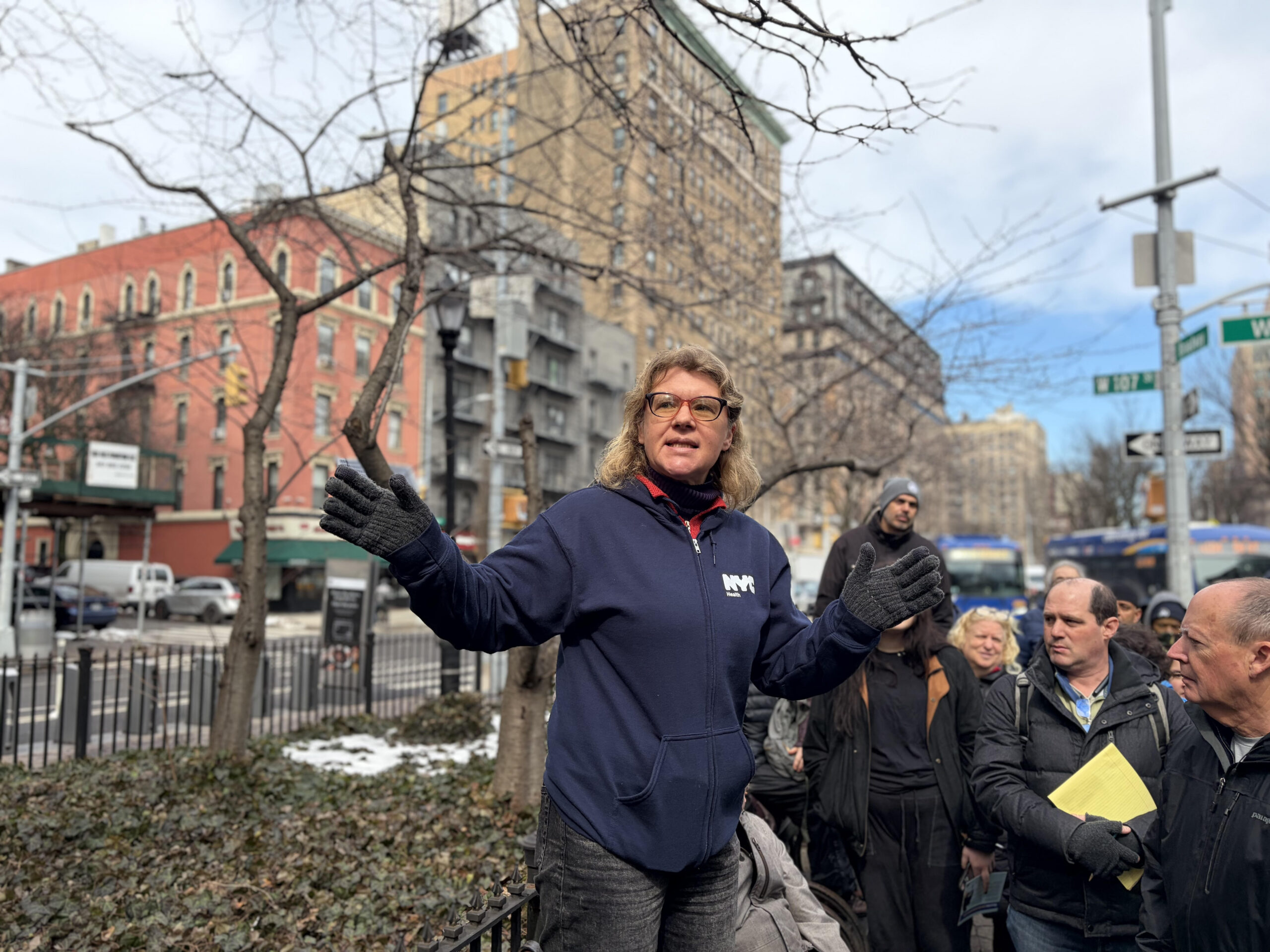
That description comes from Caroline Bragdon, director of neighborhood interventions, pest control services at the city’s Department of Health, who led a walking seminar on rats and rat prevention on Wednesday that began in Straus Park.
Bragdon has been with the Department of Health for 25 years, and hearing her speak about rats brings to mind Sisyphus pushing a boulder up a hill. From her descriptions of rat life, a reasonable goal for the city is mitigation, but not eradication.
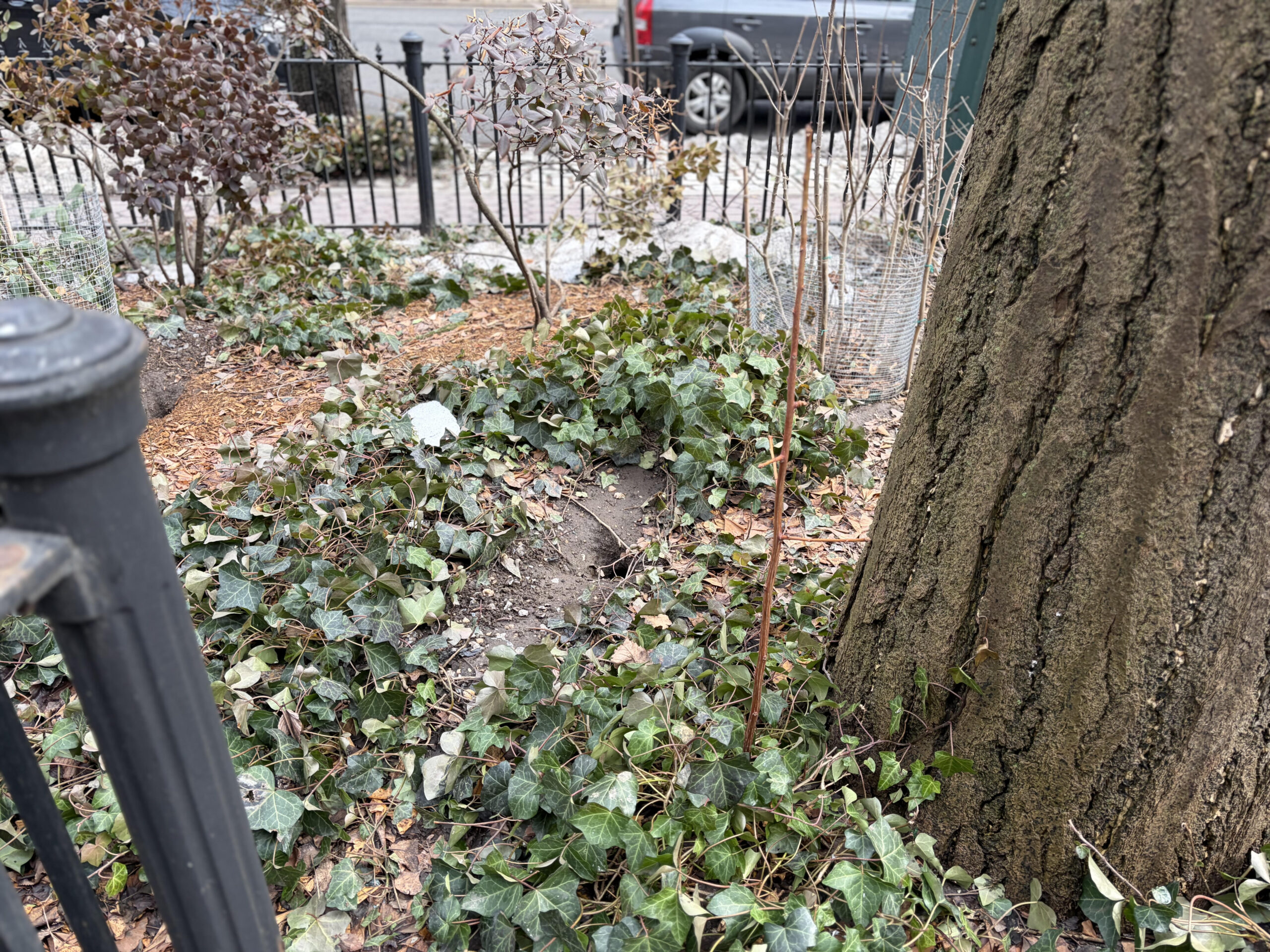
For starters, rats are incredibly scrappy – they can live on just an ounce of food a day and can squeeze their furry bodies through a hole the size of a quarter. They live underground, often burrowing into the soil of parks and tree pits. If you destroy their nest, they will simply make another one elsewhere.
Worst of all, for New Yorkers: they are prolific. A healthy rat can have 12 pups approximately every month. So even though the average city rat only lives for a year (hawks are their natural predators in NYC, but Bragdon says rats are more likely to meet their maker by way of an oncoming car), that still leaves plenty of time to create a big family tree.
So, what can we do?
Bragdon stresses the importance of limiting their food sources. Rats have a strong sense of smell and can easily find food if it’s left out in a bin without a lid. Throwing away food scraps in lidded containers – such as compost bins – and keeping garbage areas clean is the primary defense against rats. “That’s rat prevention in New York,” she said.
Also: rats are great at finding food in unlikely places. The most disgusting fact Bragdon shared on the rat tour is that rats can feed on the undigested food found in dog poop left on the street – yet another reason to pick up after your dog.
Most of the time, though, food is not that hard for rats to find. Feeding pigeons and other wildlife in the city is “always a bad idea” says Bragdon, both because the food is often unhealthy for the intended animals, and because it attracts unintended ones – i.e., rats.
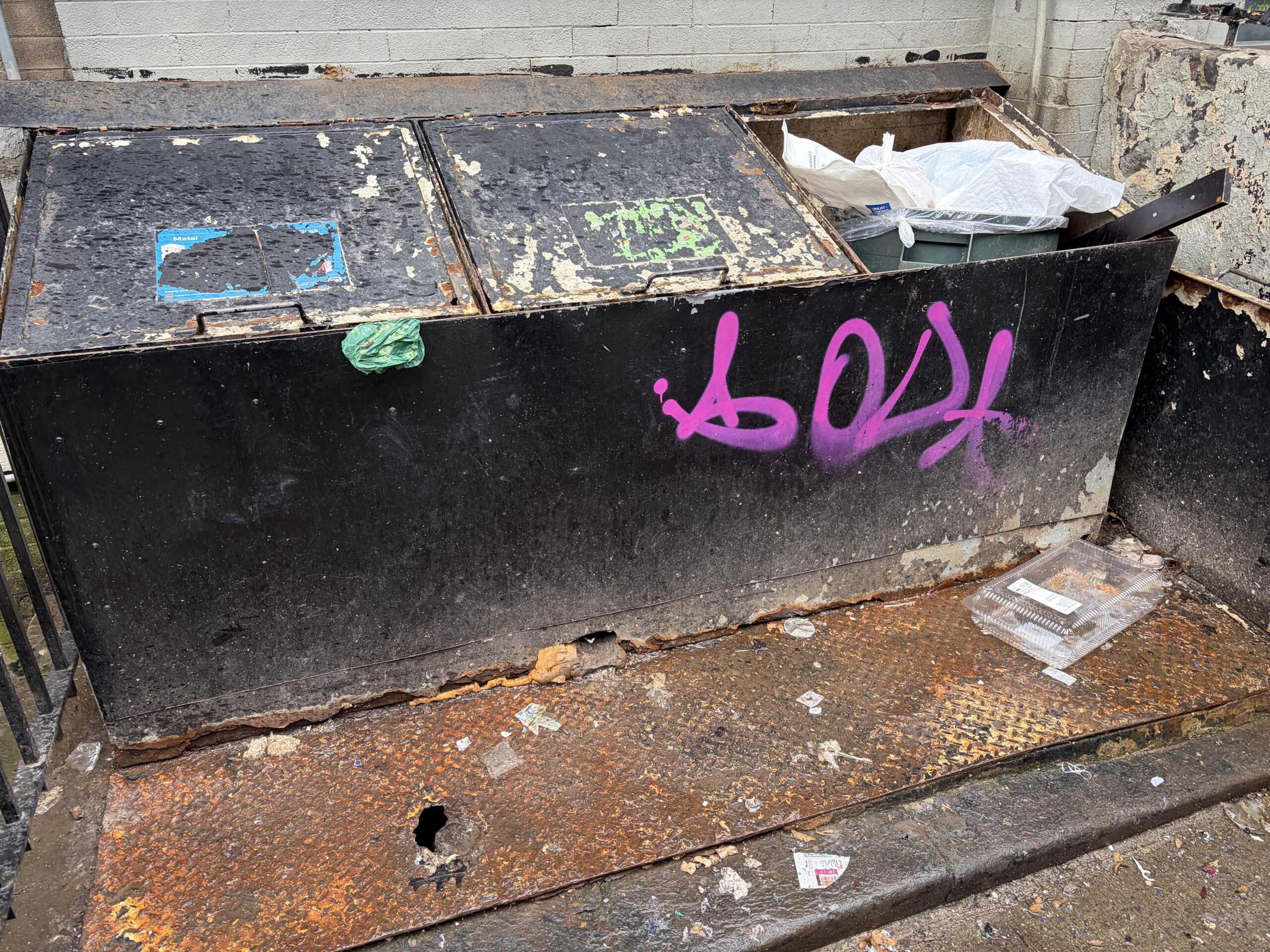
Keeping infrastructure maintained is another key step in rat prevention. Rats can make homes in cracks in the pavement and find their way into buildings through small holes in the steps or siding.
On the list of rat-fighting tactics, using rat poison is low down – partly because it’s often ineffective (rats often don’t take the bait) and partly because certain poisons can accumulate up the food chain. This is what likely killed Flaco, the owl that escaped the Central Park Zoo. Rat contraceptives are currently being trialed, but results are still uncertain.
If you see signs of rats – a three-inch diameter hole in a tree pit, droppings that look like raisins, gnaw marks on a garbage bin, for example – Bragdon recommends calling 311. That triggers an inspection by the Department of Health, the results of which can be monitored on the Rat Information Portal. The Parks Department handles tree pits and has ways to address a rat problem without harming the tree. Bragdon advises filling tree pits with gravel to make it harder for rats to create a nest. Using concrete will kill the tree.
New York City no longer has a “rat czar” – Kathleen Corradi stepped down last fall after more than two years on the job – but there are still ways for the public to get involved in the Department of Health’s rodent resistance. For example, the agency offers free rat academy trainings both online and in-person.
If you’ve read this far, you might be curious about the effect of trash containerization on rats. Last summer, the NYC Department of Sanitation reported promising early results from its use of Empire Bins in Morningside Heights and West Harlem, with rat sightings down 8% in the area.
Read more:
Subscribe to WSR’s free email newsletter here. And you can Support the Rag here.





There are several people who routinely scatter bird feed in this and nearby areas. It’s a losing battle against the rats until they can be prevailed upon or somehow made to stop. A couple drives in at least once a week to dump bird feed at the corner of 110th and Broadway, in front of the H-Mart. They have been asked many times to stop and they refuse. They don’t live in the area so don’t have to deal with the consequences of their actions.
Just curious, but who asked them to stop, and if it’s being done on a regular basis did anyone get the license plate number, and is it being reported to the city?
I’ve asked them to stop, and also have asked a lady who does it in Riverside Park. I explained that they are mostly feeding the rats and that the birds do just fine on their own (in fact, bread scraps are bad for them). They just give me dirty looks and keep on doing it
Agree. In past I’ve told people not to in the park, they are too dumb to understand. The seed is also bad for the dogs. Fines should be levied. And public education added since they clearly won’t when we tell them.
What is the city going to do?
Their job(s)?! 🙄
Several neighbors and the management of H-Mart have spoken to them, since the bird droppings are a big issue for their awnings and the sidewalk. The city and local officials have been asked to weigh in, as have the police, who have spoken to them. Everyone seems powerless to do anything. They drive an electric blue Subaru, often it’s just one or the other, an Asian woman or a white man, although sometimes they both come. They pull up, dump the birdseed, then drive off. Interestingly, the birds even seem to recognize their car.
Please clean all the garbage and trash in front of every building and sidewalk. There is a mess under the snow. The Broadway islands are loaded with trash and boxes.
I didn’t think that was a secret, but OK.
I will repeat this one more time for those in the cheap seats. The best way to eliminate rats, particularly on residential streets, is composting.
Before my block went full-on composting, I would come home at night and see at least half a dozen rats skittering between the street, hiding places – and garbage bags on the sidewalk. And we had rats living in at least half of our tree pits.
When my block (a very savvy, “cohesive” one) went full-on composting – with virtually every building complying with it , from townhouses to large apartment buildings – it took about a year or so (possibly less), but the rats pretty much disappeared. I see none when I come home late at night. and they have even left the tree pits for “greener” pastures.
I simply cannot stress enough how well composting works to decrease or eliminate the rat population on a given street. And my street is proof that it absolutely, unquestionably works.
But, as others have noted, it takes a concerted effort by both landlords and (particularly) tenants for composting to be helpful in this regard – something which is, sadly, not as easy to do as one would like, particularly given lazy tenants who simply refuse to compost (and then complain about the rats) and the occasional landlord unwilling to comply with the composting laws.
Reversing the old expression, “If you build it, they will come,” I can tell you with a high degree of certainty that, “if you compost, they (the rats) will go.”
So are you saying rats dont eat compost?
How is composting more effective, I am truly intrigued.
I’s not that they don’t “eat” composted material: they certainly would if they could. But unlike plastic garbage bags, composting bins are not accessible to the rats. So if all compostable material is removed from the plastic bags and put in an non-accessible bin, the rats would also have to find “greener pastures.”
Others here have suggested bins for ALL garbage. This would certainly be just as effective with regard to making garbage non-accessible to rats. But it would also prevent the other, positive aspects of composting. According to the DSNY:
“The NYC Department of Sanitation (DSNY) turns collected organic waste—food scraps, food-soiled paper, and yard waste—into nutrient-rich compost at a 33-acre Staten Island facility or processes it into renewable biogas energy. The finished compost is used for city parks, community gardens, or given back to residents and nonprofits.”
So simply putting all garbage together in non-accessible bins would not allow the City to actually use the composting for positive things. And it would actually cost the City MORE if those things had to be done without already separated composting.
Can I simplify that for you: composting reduces rats too.
this is so cool! I’m a huge supporter of composting and love that this is yet another benefit! (I also hope that soon, we won’t have trash bags on any sidewalks anymore and they’ll all be in bins.)
But forcing people to compost and fining them is killing the golden goose and unproductive.
Or we could just use secure, sealed bins, like every other city.
Lots of buildings, especially in other boroughs, do not compost.
Laws need to be enforced or they have no force
How is composting more effective than just putting all garbage into containers (instead of leaving it in plastic bags on the street)?
The containers are also there 24/7. Bags and wheeled containers are not permanent fixtures of the streetscape.
Actually, our composting containers are not on the street 24/7/365. They are only put out on collection days. Otherwise they are kept in our basement.
And the other garbage isn’t stinky if it isn’t full of food scraps. If the food scraps are in a closed bin, the rats can’t get to it and the other garbage is a lot less appealing
Rats are pretty resilient! Also what’s wrong with having garbage out for a couple of hours rather than 24/7/365? There is GPS technology that can drastically reduce the window garbage is waiting to be picked up.
I suppose either would work. However, separating out composting from other garbage helps the environment. I.e., the composting is taken to a different facility, where it is processed and becomes converted into natural fertilizer for parks and gardens, or processed by anaerobic digesters to create renewable biogas and biosolids. If we didn’t separate it out, it would actually cost the City more to create all that from scratch.
Tell the idiots to STOP FEEDING THE PIGEONS!! Rats feast on them.
The pigeon feeders have mental issues; the only way to stop them is to lock them up in a mental asylum. I walk to work in the early hours and at 5:30am we have a number of people out in all weather scattering shopping carts full of bird seed and crumbs on Broadway, Amsterdam and Columbus, and the side streets. I wonder if it is a diagnosed disorder among older people,.
No one is going to lock pigeon feeders i n a mental asylum when even violent repeat offenders are not locked up.
We Democrats need to affirm the importance of public safety and stop coddling violent offenders. To say nothing of compulsive pigeon feeders.
The empire bins in Harlem are a mess already. Rats can still get in. The best thing to do is have trash put out during the day. Time trash collection during the afternoon or around alternate side with trash out the morning of collection. Rats are nocturnal.
Unfortunately humans are diurnal and don’t want our streets covered in trash. If the bins aren’t working, redesign them. Lots of cities have solved this issue.
Totally agree. Trash bags on the sidewalk is no solution, day or night
Having big bins in front of your building where rats still get in and eat plastic is no solution either, 24/7/365!
Unfortunately, you’re seeing garbage on the street during the day regardless as 1) DSNY doesn’t even begin trash collection or even street cleaning until 5 AM and used to be at 6 AM for many years, 2) you will be seeing empire bins 24/7/365 outside your building versus bags for just a few hours.
Also speaking of people of people not wanting our streets covered in trash, maybe the real issue for people like Josh are that people who don’t have the privilege of living in Manhattan or certain trendy Brooklyn neighborhoods like Williamsburg or Park Slope or Brooklyn Heights ARE the trash who are undeserving of easy access to their neighborhoods and if they need access, they are to scuttle in like rats and have to feel their inferiority!
I just dump my leftover food on the sidewalk, because, why not? I let my pit bull run off leash in Central Park, and I never pick up her poop, because, why should I? I ride my bike on the sidewalk… stay out of my way!
It’s a cultural problem. It’s so common to see people feeding the pigeons, dumping pounds and pounds of rice, bird seed, whatever, around the city. Not to mention many people throw their trash, chicken bones, food scraps etc all over the streets when they want to discard them. How about the food cart people that dump rice and whatever onto the streets? This sort of behavior is so deeply embedded in these people that I don’t see a way out of the rat/filth problem. Unless there was actual enforcement (gasp), which NYers are very. vocal in their opposition to, then you can just keep dreaming about a clean city.
You think composting is the answer? I don’t disagree in theory but I’d estimate about half the city doesn’t even understand how to recycle. If they do then they are completely unbothered by throwing any type of trash in any place it fits. Sorry to say it but some of you need to wake up and see the city’s people for what they are.
I used to be so idealistic about these issues and even used to spend time regularly picking up trash off the street and bagging it. After seeing enough people blatantly littering and dumping I quit the trash volunteer stuff. Ah well.
All solutions presented here will help. A week ago there were 4 or 5:large rats grazing on the ground at 103rd and Riverside Drive. An ongoing problem caused by bird feeding.
Containerization works and composting works even better. But it takes a concerted effort of all the tools at hand.
People have to stop throwing bird seed, bread crumbs and whatever else they deem is for the birds. It is for the rats!!!!
I think it’s funny that you give “clues” to seeing rats, we see the actual rats ALL the time when walking the dog at night. Also garbage & recycling is NOT in bins in the high 90s and low 100s. Why????
If we again allow outdoor dining sheds we will be opening up a buffet for the rat population.
That is a bigger culprit than garbage bags!
The rats in West Chelsea were well fed when the restaurant sheds were up and running. They feasted on food scraps under and around the sheds then gorged on the Japanese, French and Italian restaurant garbage. Now the sheds are gone, I can finally walk on the sidewalk at night. I also don’t miss seeing the unspeakable things that humans did in the sheds at night!
I hear that outdoor dining sheds are a great place for hookups and for dogs to do their duties.
When will the Empire Bins be used throughout the entire city?
Hopefully, NEVER! They are a filthy eyesore that does nothing. The best option is to enforce curbside cleaning by building owners and businesses. The little wheelie trash bins that can be brought back from the street after collection are far superior to the car-sized.
Love the “whats the City going to do” sort of comments…the rats presence is 80-90% a people problem, we provide the food they partake and proliferate, and they advise what to do but do we pay attention and follow the suggestions? Rats will live on as they have for centuries but populations can be reduced if folk change their habits. Change is hard and the containerization of trash will over time help but. Can understand the interest in feeding out feathered friends but they will typically do OK on their own. Gets tough when we have the snow cover we have had but spreading food on the ground is less for birds and more for rodents. Its up to the people 🙂
I have 5 windows to compost from.
We should all embrace composting!!!
The secret is DOGS!! We own a whippet (great sighthound hunting dog) that loves to rat hunt. Any sighthound, TERRIERS, or hunting dogs living on every block can pick up ratting very quickly, and they actually love it. You can make a huge dent in their colonies within a week or two, and only working about a half hour at a time. We own a whippet and a german shorthaired pointer that have dispatched up to 30 rats in a day. The pointer is great at finding the rats more than our sighthound, but they are both great ratters. Some of the greatest ratters are any Terrier breed because they were bred for tracking and dispatching small critter
I hope you don’t mind feeding your dogs all the rat poison the rats eat.
It’s refreshing to read that the houseless are not being held responsible for the endemic rat population