
By Tracy Zwick
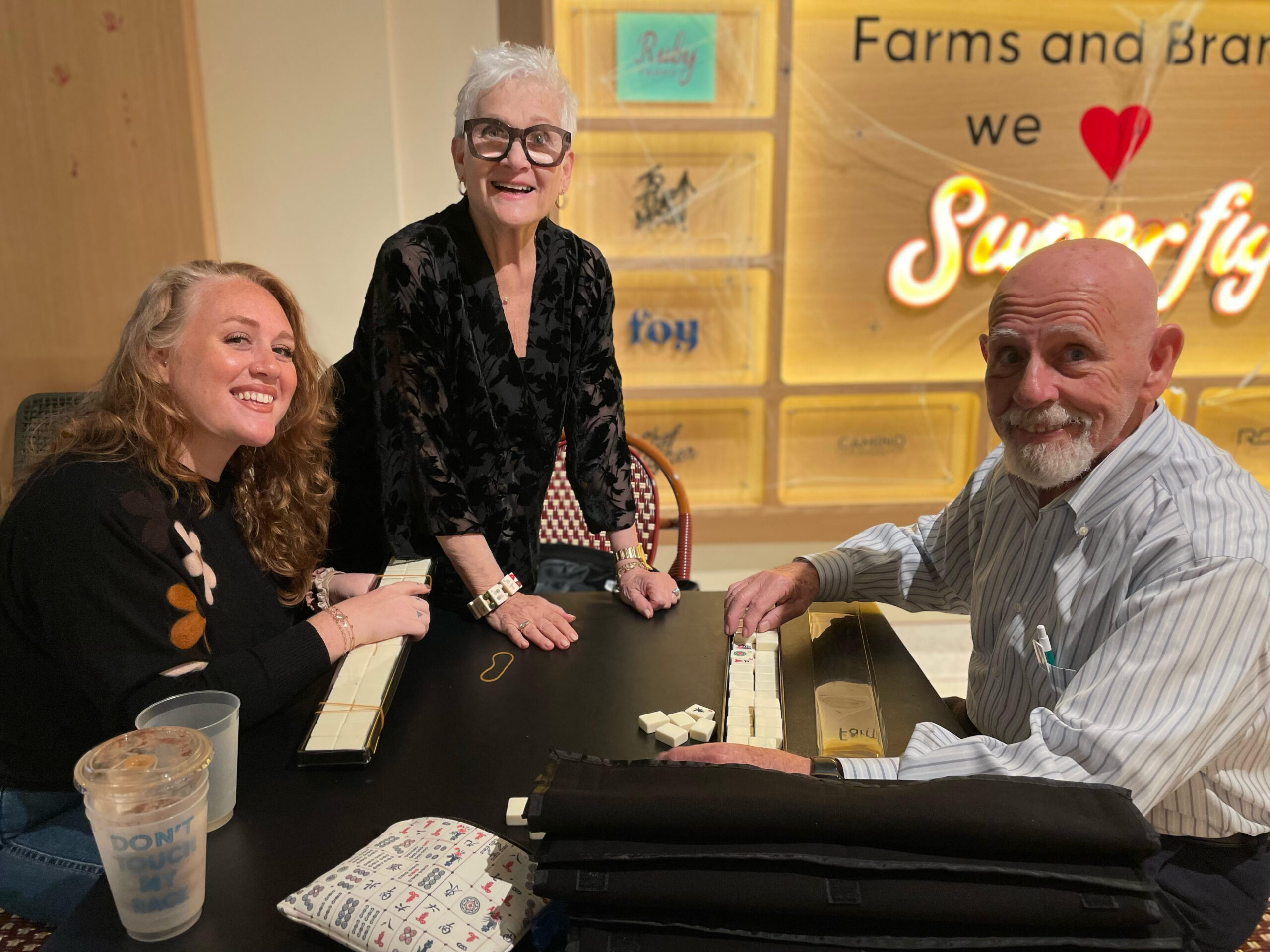
Customers looked briefly confused when they walked into Superfly Dispensary on West 86th Street last Thursday night. To reach the counter and buy vapes or infused bud, they had to weave past half a dozen mahjong tables occupied by mostly middle-aged women clicking tiles at a brisk clip.
Music thumped. Dice rolled.
Between games, representatives from botanical outlets explained the virtues of adaptogenic mushrooms and offered samples of THC/CBD edibles designed to ease PMS symptoms and facilitate serenity.
Mahjong has been turning up in unexpected places on the Upper West Side.
Once associated with chintz-filled living rooms, folding tables, and a particular stage of life, the tile-based game—developed around building specific hands, somewhat like poker—has undergone a rebrand. Originating in China, mahjong became popular among Jewish women in New York in the 1920s, then settled into a long domestic afterlife.
By the 2010s, it had emerged in a new light. Sarah Jessica Parker posted about her weekly games and luxe tile sets. Local players started hosting lessons, often with well-known teachers like Bonnie Tchapraste, whose classes and events have helped anchor the game’s revival on the Upper West Side. Then the pandemic hit. The game went quiet, its shared tiles and close conversation suddenly suspect.
When pandemic lockdowns gradually lifted, so did tensions around playing mahjong. In recent months, Jenna Bush Hager and Savannah Guthrie have proclaimed on national television that they’re “addicted” to the game, calling it “seriously satisfying.” Retreats promising days of uninterrupted play now pop up at posh resorts in places like Washington, Connecticut and Johns Island, South Carolina.
On the Upper West Side, there’s no need to travel.
Storefronts like Mochi Dolci on West 79th Street, and Chaotic Good on West 84th Street host regular games and lessons. Hex & Co., the gaming cafe on Broadway near West 114th Street, usually offers mahjong for stay-and-play, along with sets for sale. Community gathering places like Stephen Wise Free Synagogue offer games too.
The game at Mochi Dolci, which is Chinese Mahjong and not American Mahjong, has become so popular that it is at capacity and not currently accepting new players.
Last week, as temperatures dipped into the single digits, Congregation Rodeph Shalom on West 83rd Street was warm as toast for its monthly mahjong night. An assistant principal from nearby P.S. 9 quietly assembled a “consecutive numbers” hand, mahjong’s version of a straight. At another table, a New York Times newsroom executive clicked tiles with a hedge fund lawyer who’d recently learned the game. The room rang with periodic shouts of “Mahjong!” – followed by applause, groans, and the clacky reshuffling of racks. Popcorn, drinks, cookies, and carrots were laid out on a side table, supplied by the shul.
“We’re making mahjong big again here,” said Scott Hertz, who runs programming and marketing at CRS. In addition to the monthly evening game, the synagogue now offers lessons and weekly daytime open play. “It’s insane how much interest there is.”
At the Marlene Meyerson JCC on Amsterdam Avenue at West 76th Street, the mood was more disciplined. During a recent beginner session, veteran teacher Julie Azous guided eight new players through their first supervised rounds. She patrolled the room, peering over shoulders and rearranging tiles. “Where are you on the card?” she asked one player. “Feel free to rack those tiles,” she encouraged another. When a third hesitated too long over a discard, she cut in: “Way too long.”
Azous has taught mahjong at the 92nd Street Y, the Harmonie Club, the Cosmopolitan Club, and privately throughout Manhattan. At the JCC, her four-session series starts at $152. Mahjong, it turns out, now comes with its own ecosystem: teachers, open play, sponsored nights, designer and vintage tiles, and a steady stream of newcomers, from preteens to retirees, trying to master the rules and make connections.
Playing is only part of the appeal. There’s tile design to appreciate, mahjong history to learn, and the annual release of the official National Mah Jongg League card to anticipate each spring. Unlike most card games, the hands required to win change every year, forcing even experienced players back to cramming.
Most players insist the allure goes beyond strategy and aesthetics. At a January event at The Center at West Park organized by Tchapraste, who also oversaw the Superfly event, UWSer Debbie Hirschman described mahjong as “about community and connection.” She was seated next to her friend Ellen, whom she met through animal therapy. Ellen had another reason for playing mahjong: “I like that it works my brain,” she said.
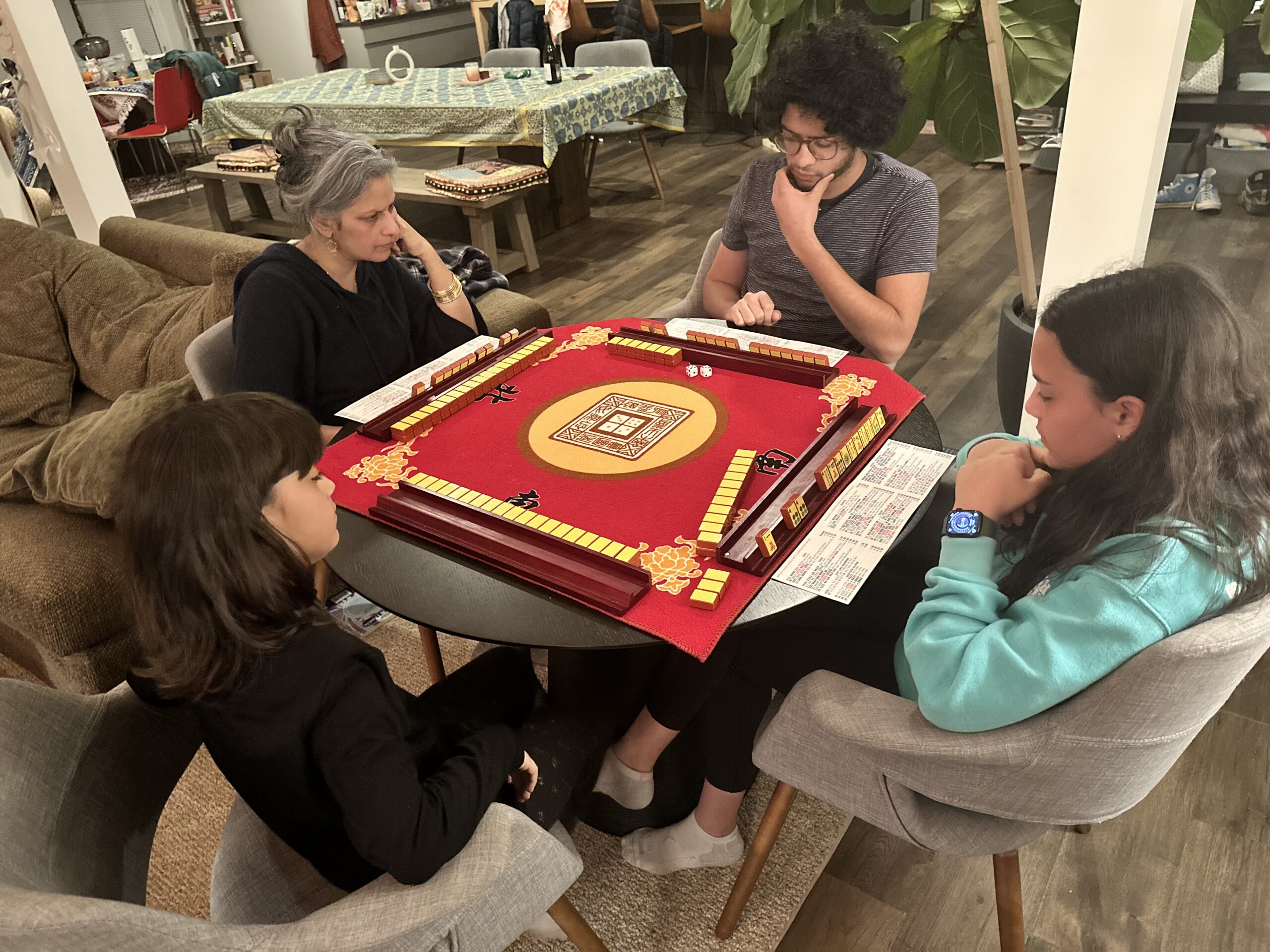
UWSer Mo Shome made mahjong a family affair, teaching her nieces to play before they turned 10. Now 11 and 13, they’re mahjong sharps. “They beat me all the time,” Shome said. “Nothing makes me happier than clicking tiles with them, and seeing them call mahjong.”
On the Upper West Side, the game now unfolds across generations and settings—synagogues and rec centers, cafés and, occasionally, cannabis dispensaries—linked by the familiar sound of tiles clicking, and the feeling of community.
Subscribe to West Side Rag’s FREE email newsletter here. And you can Support the Rag here.





Check out the Facebook group https://www.facebook.com/groups/manhattanmahjong for even more games etc. on the UWS and elsewhere.
Thanks, Sharon!
It isn’t detailed in the story, but AMNH hosted a mahjong night in January too. It was reportedly well attended: https://www.amnh.org/calendar/east-asian-culture-festival
Bonnie and Schahan are great people. The UWS is a better hood with them as a part of it!
We love reading about mahjong. Join us on Facebook.com/groups/MahjongCommunity and our upcoming Launch of the 2026 NMJL Card at the 92NY on April 8, 2026. Tickets available on 92ny.org/event/mah-jongg-2026
As a Mah Jongg teacher for over 20 years, both in the suburbs & now @ the Himan Brown Senior Ctr. affiliated with the 92NY, I am continually delighted to see Mah Jongg spreading among different generations. That will insure the game remains “alive & well” for years to come, introducing people to the joy of community through the “clicking” of beautifully carved, esthetically pleasing tiles. May the games begin!
LOVE, LOVE, LOVE THIS ARTICLE. NOT ONLY INFORMATIVE, BUT BEAUTIFULLY WRITTEN. I WILL DUST OFF MY SET, WIPE MY CARD CLEAN, AND HEAD OUT. PS-MANY SYNAGOGUE SISTERHOODS SELL THE CARDS AND RECEIVE MONEY BACK FROM NATIONAL!
Congregation Habonim, 64th and Amsterdam also has a robust Mah Jongg program. I learned to play at their classes and their open play is so friendly, welcoming and patient with beginners. Information about their program is at https://www.habonim.net/mah-jongg#
I also hear that they are going to be offering Canasta lessons soon.
Great instructors at Habonim and a great crowd to play with!
Would love to learn how to play but don’t want to sign up for a series if I am not sure it’s for me. Want to learn American version bc that’s the one my friend plays with her group.
Any one off beginner sessions (in evening – can’t go during day). Love the idea of it being at a dispensary too… lol. When does chaotic good offer games?
Is it still largely played by women. Are the number of men players growing?
Had a chuckle at this. I wonder if the dispensaries’ product would help my very single-threaded brain cope better with games that require keeping track of multiple paths simultaneously. (Mah Jongg is one.) LOL
parody of Stephen Foster’s “The Camptown Races”
The Catskill ladies sing this song
Hoo-hah, Hoo-hah,
Sitting on the front porch playing Mah-Jongg
All hoo-hah day
-Allan Sherman
My Son, the Folk Singer