
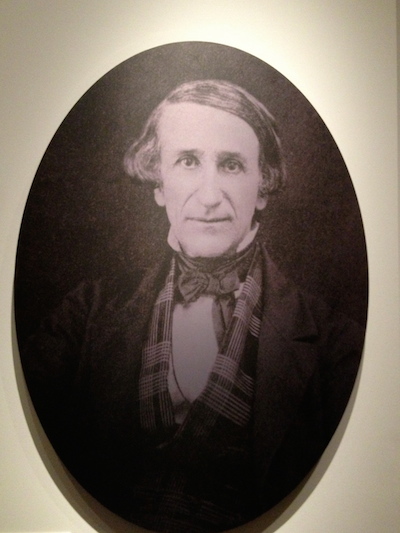
Abraham Jonas, one of Abraham Lincoln’s Jewish friends.
By Nancy Novick
At the New York Historical Society’s new exhibit “Lincoln and the Jews,” even the most avid of Civil War history buffs may learn something new about our 16th president and his attitude toward the nation’s small but growing Jewish population — in 1862, just 150,000 of the country’s 31 million citizens were Jewish. Arranged in chronological order, the exhibit describes the role of Jews during this era, as well as Lincoln’s interactions with individual Jewish associates.
Abraham Lincoln’s relationship with Abraham Jonas, a member of the Illinois State Legislature, is a significant focus. An early supporter of Lincoln, Jonas began promoting him for presidency following his defeat in the senatorial race against Stephen A. Douglas in 1858. Evidence of their ongoing close relationship is on display in the form of a letter written by Jonas to Lincoln in 1860, which warns of an assassination plot before the President’s first inauguration. Jonas learned of the plot through extended family members. Lincoln later appointed Jonas to the federal position of postmaster of Quincy, Illinois.
Despite their friendship, other members of the Jonas family were not in Lincoln’s camp. During the war, five of the Jonas sons lived in the South and fought against the Union. One of the two Jonas daughters married a Southerner, and a remaining brother, who fought in the Union army “may well have faced his Confederate brothers on the battlefield at Shiloh” according to a wall text. These divided loyalties mirrored those in many families at the time.
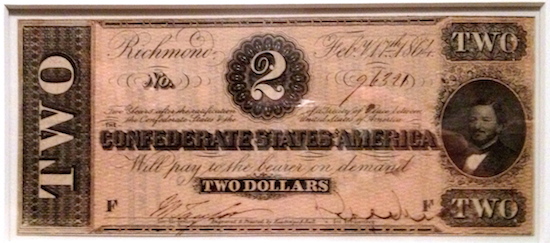 Other fascinating examples of the more than 80 artifacts included in the exhibit are the dueling pistols used by Civil War hero Edward S. Salomon, leader of the “Jewish Company” from Illinois; a Hebrew flag given to Lincoln by Jewish leader Abraham Kohn; a confederate $2 bill (at left) bearing the image of Judah P. Benjamin who served as Secretary of State in the Confederate cabinet (and the only Jewish person every pictured on American currency); and Lincoln’s letter written on behalf of podiatrist Issachar Zacharie, who the president sent to New Orleans to build pro-Union support among the city’s Jewish residents.
Also of interest is the description of Jewish themes in the arts. Of course, Lincoln’s interest in the theater is universally—and tragically—known.
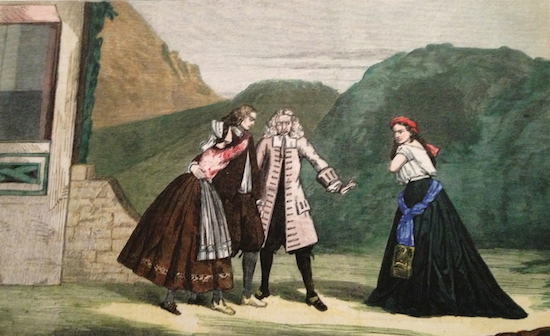 According to the descriptive text, in 1864-1865 the Lincolns attended “at least four Jewish-themed plays,” among them Gamea, or The Jewish Mother and Leah, the Forsaken (depicted at right). While the latter title may briefly spark associations with Woody Allen or some contemporary off-Broadway offering, it was, in fact, a work about a kidnapped Jewish child raised by a Christian family, written by an African-American playwright who was probably more concerned with displacement and identity.
A few of the items bear a somewhat tenuous relationship with the President, but nevertheless add to the viewer’s sense of the era. A photo of the house across from Lincoln’s in Springfield, for example, notes that Lincoln probably never knew the Rosenwalds, the Jewish family who moved into a home across the street from one he owned (although Lincoln may have known other members of the family). By the time they arrived, the President had already departed for Washington, D.C.
While there is no mention in the exhibit of the relationship Lincoln’s successor, Andrew Johnson, had with American Jews, visitors will learn about the attitude toward Jews of another future president, Ulysses S. Grant. During the war Grant blamed Jews for profiteering and issued orders to his soldiers “to examine the baggage of all speculators coming south, adding ‘Jews should receive special attention.’” Grant’s antipathy toward Jews increased and in mid-December of 1862, the general “issued [an order] expelling ‘Jews as a class’ from his territory.” When the order came to Lincoln’s attention, he immediately revoked it.
Evidence that Lincoln’s commitment to equal rights extended beyond his championing the cause of African-Americans is reflected in this quote, also on display: “How can anyone who abhors the oppression of negroes be in favor of degrading classes of white people?”
Lincoln and the Jews was inspired by the publication of Lincoln and the Jews by Professor Jonathan D. Sarna of Brandeis University; the exhibit continues through June 7.
Nancy Novick blogs about the written and spoken word on the Upper West Side at westsidewords.com.


This was a fascinating article to read! This is something I never learned in public school
or even at CUNY about our 16th President! Lincoln,who read his famous “A House Divided” speech at our illustrious COOPER UNION,in 1860…always struck me as a man who was about diversity,even at a time when,for many,it was just a dream!This is one of the reasons why I’d love to write for your paper!