


The Bloomingdale Neighborhood History Group was established by a group of Upper West Siders who share an interest in the history of the area they loosely define as stretching from West 96th Street to West 110th Street, the Hudson River to Central Park.
By Pam Tice, member of the Bloomingdale Neighborhood History Group
New York Magazine’s Curbed featured an article this week about the “zone of pedestrian death” on the Upper West Side around West 96th Street. Traffic deaths, it seems, are an evergreen topic.
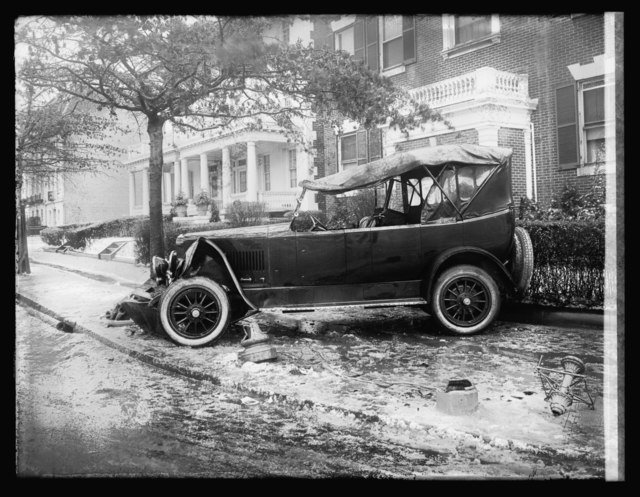
Recently, while scrolling through issues of the 1923 Daily News, looking for 100-year-old history stories, I was struck by the number of automobile accidents and deaths there were in our neighborhood. In fact, the Upper West Side is famous for being the site of the first motor vehicle fatality in the United States. On September 13, 1899, Henry Bliss was killed by a passing taxicab as he stepped got off a trolley car at W. 74th Street and Central Park West.
In June, 1923, Mrs. Howland of West 95th Street was killed by an automobile while on her way home from St. Agnes Chapel on West 91st. Also in June, 13-year-old Theresa Bogert of 933 Columbus Avenue was killed at Riverside Drive and 108th Street, while crossing with two young friends and a teacher. In the winter, a snowplow had killed a man on West 106th Street. Little Jimmie Walsh of Amsterdam Avenue was killed in April.
Also in April, readers of the Daily News were reminded of the law that automobiles had to stay eight feet away from the area where trolley car passengers were discharged, with a reminder that two people had been killed recently at Columbus and 98th Street getting off the cars, a particularly dangerous location.
The Parks Commissioner threatened to close Central Park to automobiles after dark due to the damage done to the Park’s plantings and structures. In June, an auto travelling at 50 miles per hour crashed into a lamppost at West 102nd Street, killing the driver. There were other incidents involving automobiles, whose drivers the News referred to as “autoists.” The word “car” was reserved for trolleys.
Two autos with alleged bandits inside crashed at Riverside Drive and 97th Street. A young woman, screaming and clinging to the running board of an auto that sped down Amsterdam from 86th to 66th Streets with 50 autos giving chase, ended up in an overturned auto with a bad injury. Just south of Bloomingdale, a speeding auto hit a crosstown bus, exploded its gas tank, and kept going as a ball of fire for several blocks since it was speeding at 40 miles per hour.
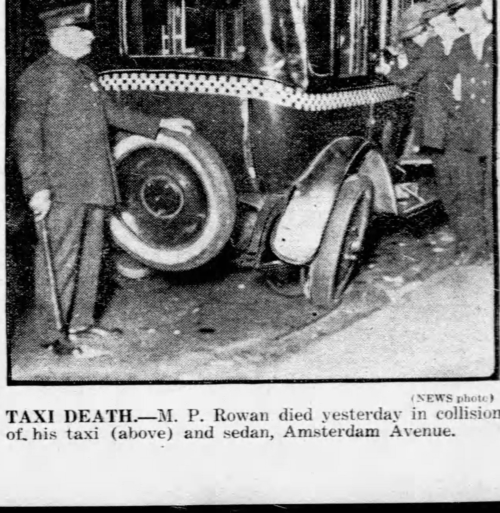
What I was seeing in the news was the tremendous growth of automobile ownership in the 1920s, and the arrival of the American automobile age. The streets had to be turned over to automobiles. In January 1923, The New York Times reported on the opening of the national Auto Show at the Grand Central Palace, where it was promised that 350 models made by 79 different manufacturers could be seen. The Times reported that 300,000 cars were now registered in New York City.
The streets in New York were not ready for this traffic. There were no painted lines, very few traffic lights, and a police department struggling to bring order to the streets. “Jaywalking” (an insult: walking like a “jay” or “rube”) was seen as a right by pedestrians, and children played in the streets, as not that many playgrounds had been built for them.
Traffic lights were introduced starting in 1920, but the first ones, mounted on wooden towers at intersections, were only on the busiest streets: Fifth Avenue at the intersections of 14th, 26th, 34th, 42nd, 50th and 57th Streets. These were later replaced by bronze towers. The intersections in Bloomingdale might have had traffic policemen on some busy corners, perhaps helped by a manually-operated semaphore telling the driver to Stop or Go, a tool borrowed from the railroads that the police department adapted to auto traffic.
According to the traffic rules printed in Rider’s New York City Guide for 1923, the speed limit in the city was 15 miles per hour, and 8 miles per hour at intersecting streets in congested areas. In more sparsely settled areas, the speed limit was 25 miles per hour.
The slaughter of pedestrians by automobiles, including so many children, was happening all over the U.S., particularly in cities. The Daily News began to regularly report a disturbing picture of 1923 New York City. The medical examiner released the numbers of people killed by guns, autos, and “moonshine” which the News converted to little circular clock-chart labeled “the hands of death” several times during the year. The latest one in 1923, dated December 31, showed 889 people killed by automobiles.
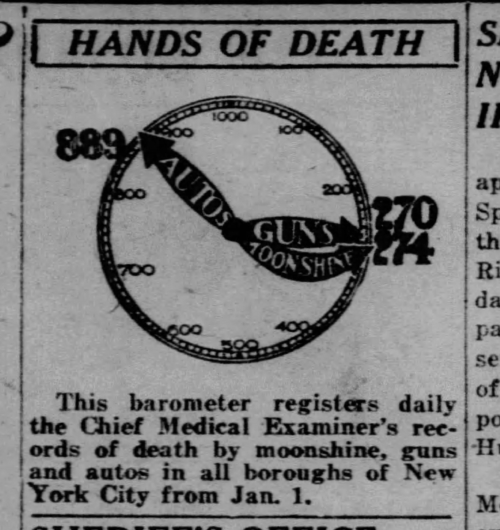
The high number of auto deaths in 1923 was not new. In 1922, The New York Times reported that there had been 964 deaths by automobiles with 477 of them the deaths of children.
In 1923, several solutions were proposed or tried. The News reported that Mayor John Hylan wanted to convert many of the trolley surface lines to bus routes so that people could access the vehicle at the curb, not in the middle of the street where they might be hit by a careless driver. The Board of Education declared a “Safety Day” late in the school year, trying to impress school children about the dangers of the streets. The schools also initiated a procedure at the end of the school day whereby the children would stand up just before dismissal and be reminded by their teacher for two minutes about the danger of playing or running into the street.
Magistrates at the city’s traffic courts began imposing harsher sentences. The police department introduced new techniques with very loud whistles and initiated a system of checking auto brakes.
The Daily News kept reporting on their “hands of death” from 1924 to 1933 when the charts disappeared. Legalized liquor had diminished moonshine in 1933. Perhaps death by automobiles and guns was never to be solved and just part of modern life. In 1931, auto deaths reached a high of 1,448.




The very first fatal auto accident in Manhattan was in 1899 . . . fellow hit by a taxi . . . . which happened to be electric (Go figure!)
This was at CPW & 74th.
I knew this previously because it’s the end of my block so having read this many years ago, made note.
https://en.wikipedia.org/wiki/Death_of_Henry_H._Bliss
Electric trucks arrived on scene over 100 years ago, by late 1800’s.
During early decades of 1900’s their use (largely by commercial businesses) grew. Famous and now defunct Pilgrim Laundry in Brooklyn used a fleet of electric trucks to collect and deliver laundry.
https://www.newsweek.com/100-years-before-gmc-hummer-ev-tesla-cybertruck-electric-trucks-were-popular-1660569
Does anyone know if historical plaque still exists at that corner and where? I live nearby and don’t recall ever coming across it.
I still see old 69yo Henry H. Bliss the real estate dealer to this day at the corner of 74th St., CPW looking north waiting at the stop light looking at the trolley car and than a electric-powered taxicab I believe it was Automobile No. 43 that struck him and then vanishes into thin air and then reappear’s next day doing the same thing and then disappears….around 6pm over and over each day. The old guy dresses for the weather. Seems like a very nice old gentleman. 👀
Great article…I never tire of seeing stories about old NYC and the UWS. Of course, I do like the happy ones more than those that are sad. But they do remind us that many of our “current” issues/challenges are not really new.
The word “accident” rarely explains traffic violence. Most •crashes• result from deliberate choices by drivers, street designers, vehicle manufacturers.
We just love paying for cars and their damage.
It wasn’t just NYC, but many other urban areas in USA and Europe were seeing high numbers of deaths due to automobile accidents from late 1800’s through say 1930’s.
https://www.detroitnews.com/story/news/local/michigan-history/2015/04/26/auto-traffic-history-detroit/26312107/
Part of this was that streets were packed not just with pedestrians but street cars, trolleys, horses, horse and buggies/carts, trains (11th avenue below 34th street was called “Death Avenue” because NYCRR ran trains down ROW. This was reason why High Line was built), and now came motor vehicles.
NYS did not begin mandating drivers licenses until 1919 with laws expanding in 1924.
https://www.co.seneca.ny.us/wp-content/uploads/2020/01/A-History-of-the-Vehicle-and-Traffic-Law-in-New-York-State-ADA.pdf
Even with those laws formal drivers education and learning about vehicle safety wouldn’t take time. In meanwhile many
drivers then as today got their thrills by pushing their motor vehicles to limits (speeding) with sometimes disastrous results.
For comparison view these films showing street life in NYC.
1911
https://www.youtube.com/watch?v=FWtWJAmHuc8
1920
https://www.youtube.com/watch?v=GUZ0jTU1o5s
City would not get its first sort of traffic light until 1920 (on Fifth Avenue), but as that decade wore on it became clear automobile was causing major problems that needed sorting.
From NYT:
“In 1913 The New York Times reported on the city’s “Death Harvest” — that’s the actual headline — from 1910 and 1912 for three different types of vehicles: the number killed by wagons and carriages, down in two years to 177 from 211; and streetcars, down to 134 from 148. But automobile fatalities nearly doubled, to 221 from 112. Ninety-five percent of the dead, according to The Times, were pedestrians. (In 2013, 156 pedestrians were killed by automobiles.)”
https://www.nytimes.com/2014/05/18/realestate/a-history-of-new-york-traffic-lights.html#:~:text=There%20had%20been%20an%20experimental,physician%20fascinated%20by%20street%20conditions.