

By Allan Ripp
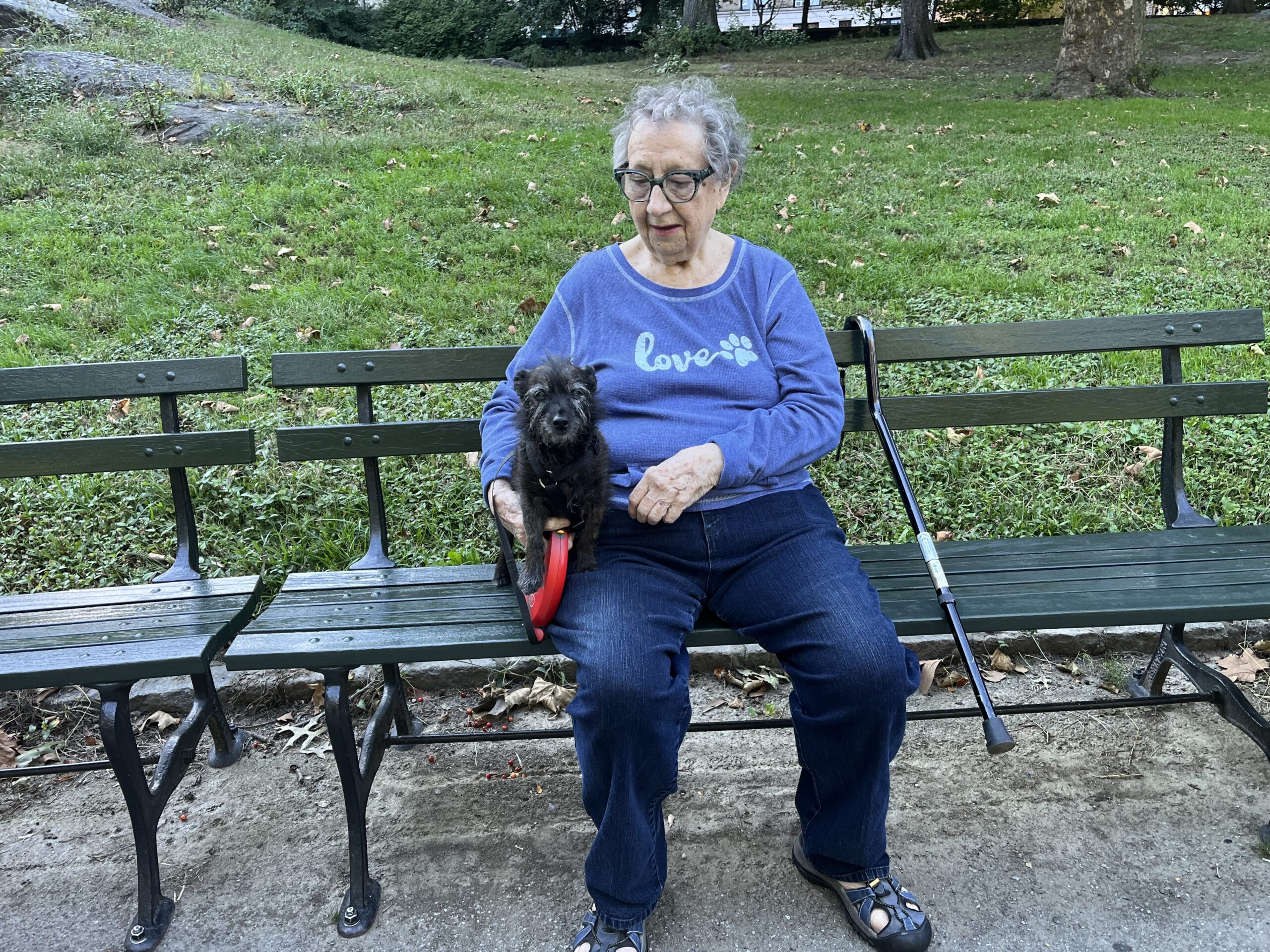
My neighbor Jane is an old dog lady. Or maybe an old-dog lady. Either way – I mean it as the highest compliment.
Jane is indeed an elder – she’s 89. However, “old” in this case refers not to Jane but to the aging canines she’s adopted over the past 15 years.
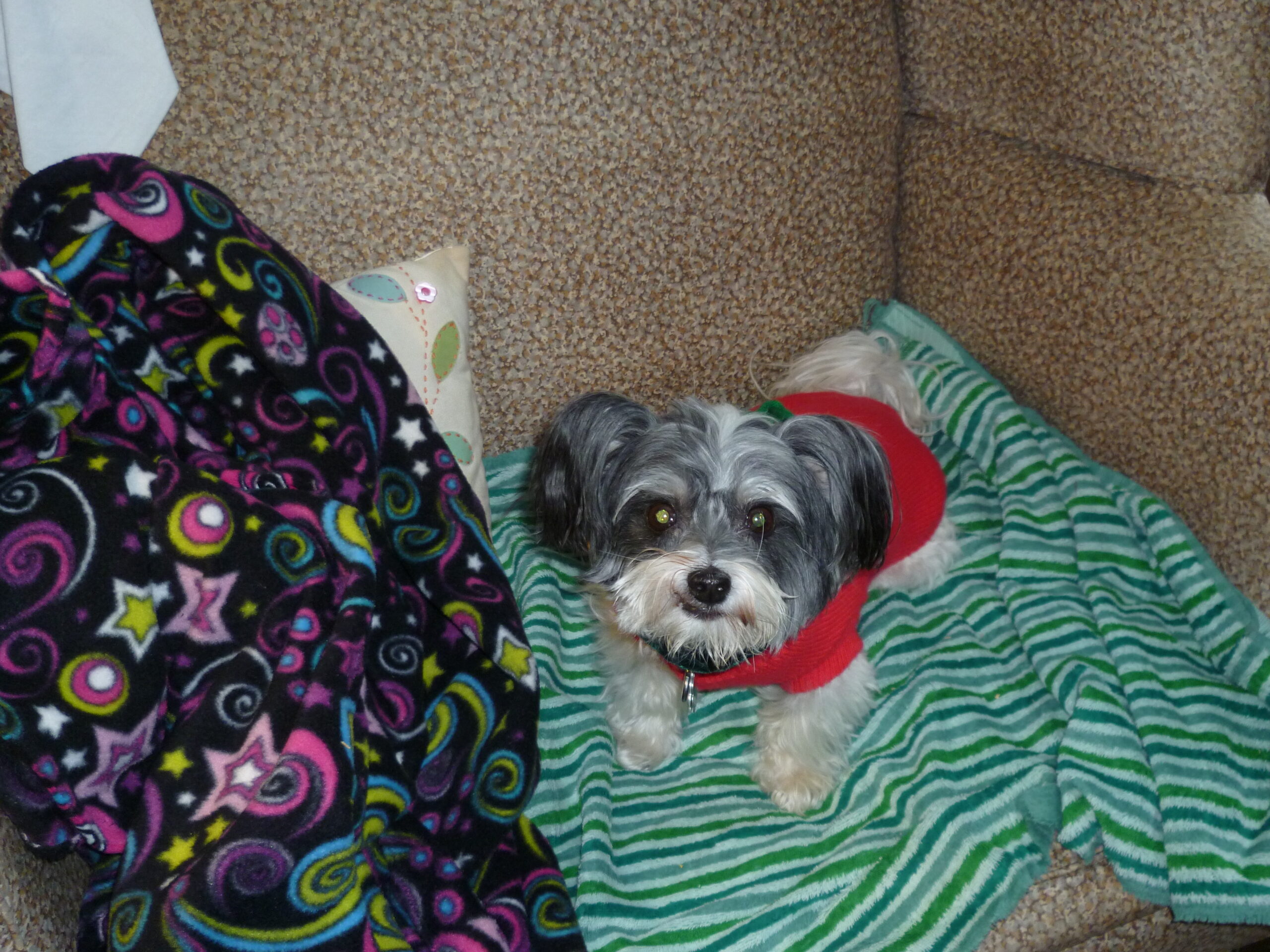
First was Lulu, a 10-year-old Havanese mix from Florida, whom Jane rescued in 2011 and kept close for seven years, holding Lulu on her lap when she passed from a blood disease in 2018. “She wasn’t a cuddler but had a great temperament and we bonded well,” Jane remembers.

Next came Oliver, acquired at age 12 from New Jersey in January 2020 just before the pandemic. His DNA profile showed mini-Poodle, Bichon Frise and Pekingese. “I was relieved the Pekingese wasn’t obvious because I can’t stand the scrunched-in faces,” Jane says. Despite a severe heart murmur he lasted five years and was “quite a mover.”
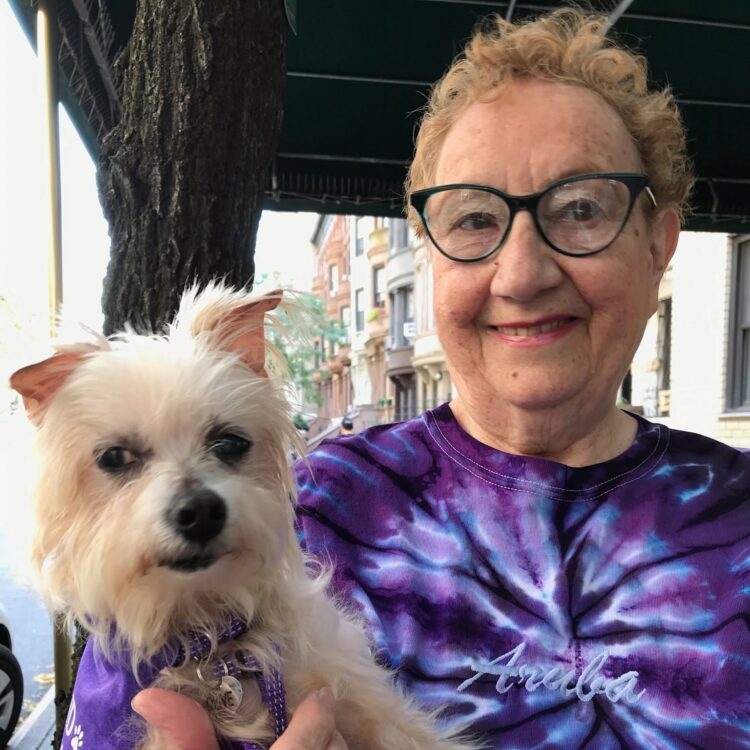
She’s also fostered old-timers, including an 11-year-old tan scruff she called Olive. “She was deaf and blind and walked into the furniture,” Jane shares, and ultimately adopted by a woman who housed other visually impaired dogs. “I wanted to keep her but it just wasn’t a good fit.”
A retired psychiatric nurse and psychotherapist, Jane has lived in the same Upper West Side apartment since 1970, almost always with a dog. When she first moved into her place on West 96th Street, a pack of feral dogs roamed nearby Central Park. One day she took home a park stray, whom she named Vespri, after a Verdi opera called I Vespri Siciliani she attended that evening at Lincoln Center.
“I didn’t want to leave him alone but had great tickets, so I put him in the bathroom with the light on and a bowl of food,” she recalls of the Shepherd-Collie mix, who stayed on comfortably a dozen years. “Vespri was 45 pounds but as I got older my dogs got smaller.” She had a total of six, including several raised as puppies, before realizing she was a better match with seniors, even if they came with health issues.
“None of us knows how long we’ve got – why not take in an older dog?” she figures. “They need less training, are more settled and we can grow older together.” They also cost a lot less than breeder dogs – Jane’s purchased several of her adoptees for around $300.
On the other paw, “expect more vet bills and pre-existing conditions, no pet insurance and trouble getting an old guy out in bad weather,” she admits. “Plus, it’s not so easy to bend over for pick-ups.” She’ll sometimes call on a dog walker when conditions are tough.
The ASPCA estimates nearly 3 million dogs are housed in shelters annually – including a large portion of older dogs, age 7 and up. But only a quarter of those find homes, compared to 60% for younger ones and puppies. “Very senior” dogs are generally 10 and up.
Despite ample supply and need, Jane says she’s encountered hurdles for her senior adoptions, often receiving no response from multiple applications. “One rescue agency tried to talk me out of it because of my age, saying their older dogs had been through trauma and might snap at me. And warned I might trip over them. I told them I’d owned dogs all my life and that wasn’t happening.” With no family nearby, she persuaded her cross-the-hall neighbor Mark to be her co-adopter.
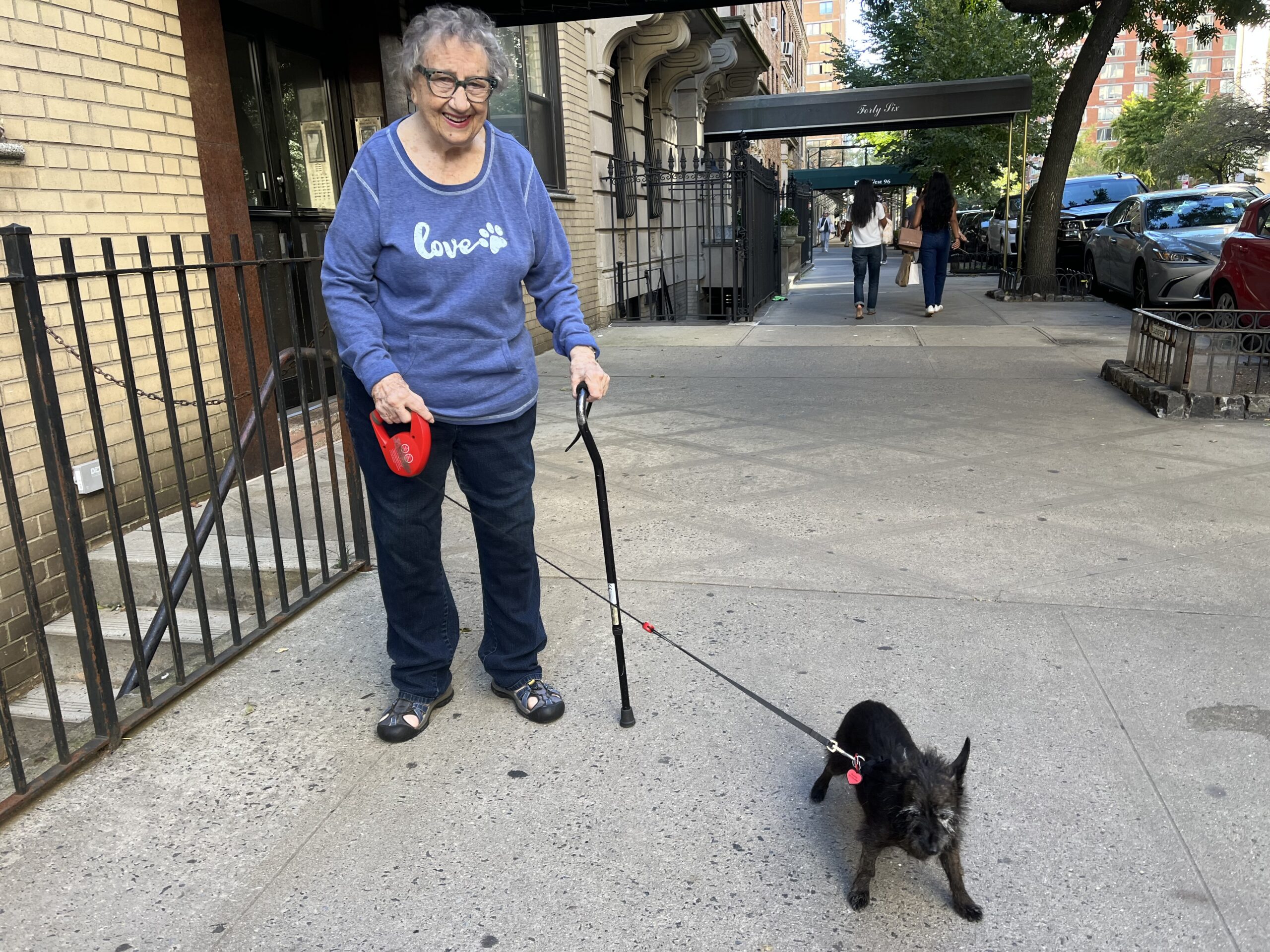
That arrangement helped her secure Piccola, 13, a fetching Dachshund-terrier mix with “batwing ears” as well as double cataracts and only three teeth, whom Jane adopted in August from a Petco meet-up in Union Square. A stray from Kentucky, “she’s the most affectionate one I’ve ever had, always kissing and licking, loves people and other dogs, but definitely has her own agenda,” Jane describes. “I’m sure she had a good home before being out on the streets.”
Piccola’s had a few alarming growths but biopsies were benign. “She’s very attuned to me but we’re working on leaving her alone in the apartment,” Jane says. “I’m wondering how she’ll handle her first New York snowfall.” With a box full of outerwear and accessories accumulated from five decades of dog ownership, Jane’s picked out a couple of sweaters and ponchos that nicely fit her 10-pound, 7-ounce adoptee.
Jane is grateful for how far local canine care has matured with her. “Thirty years ago there were few dog services in this neighborhood – no walkers, daycare, groomers. I had to go down to the West 70s just to find a vet,” she says. “Now the Upper West Side is teeming with dog providers.” She credits her longtime vet Bonnie Brown of Gotham Veterinary Center on Columbus Avenue with first urging her to go the senior route.
She’s mindful of the mortality timeline at work in elder adoptions – her own included. “I’m sure up there!” she declares. “I’m actually hoping I’ll be the first to go, since my dog has already been through so many adjustments including being re-homed several times.” That’s partly why she asked her neighbor to be co-guardian.
“But I realize that sounds a little selfish,” she adds. “Of course, you have to be prepared for heartache to come sooner when you take a dog that’s at least 10 or older. You need time to process the loss and decide whether to take a new one – for me, the pull of having another living thing around is too great, and I would probably do it again.”
Can old dogs and their owners learn new tricks? “We’ve both figured things out by now and may seem set in our ways but you adapt to one another,” Jane says. “A dog takes me outside, away from my aches and pains. We both socialize, exercise a little. Mostly, we’re just good companions.” Little Piccola, lying on the couch next to her, doesn’t disagree.
Allan Ripp runs a press relations firm in New York.
Subscribe to West Side Rag’s FREE email newsletter here. And you can Support the Rag here.



Bless you, Jane.
Jane at 89 is understandably unsteady on her feet and using a cane. How does she bend over and clean up after her dogs let aline while holding a leash and a cane?
Love.